Microcracks and Snail Trails in Solar Panels: What They Mean for Performance and Warranty
How microcracks form in solar cells, why snail trails appear along them, how electroluminescence and thermal imaging reveal cracks, and when cracked modules need replacing or a warranty claim.

Modern solar cells are thin slices of silicon, typically around 150–180 micrometres thick — about twice the thickness of a human hair. Silicon is strong but brittle, and cells can crack without any visible damage to the glass. These tiny fractures, called microcracks, are one of the most common hidden defects in PV modules. Sometimes they make no measurable difference for years; sometimes they grow, isolate parts of a cell and cause hotspots and significant power loss.
A visible clue is the "snail trail" — a thin, dark, silvery or brownish line on the cell surface that looks like a snail has crawled across the module. Snail trails usually follow crack lines. This guide explains both, how to detect them, and what they mean for performance and warranty.
Quick answer
Microcracks are fractures in solar cells caused by mechanical stress during manufacture, transport, installation, foot traffic, wind or hail. Snail trails are discoloured lines that commonly form along cracks as moisture and chemical reactions affect the silver contact paste. Small cracks may have little effect, but cracks that isolate cell areas reduce output and can cause hotspots. Electroluminescence (EL) imaging is the most reliable detection method. Documented, significant cracking from manufacturing or transport is a warranty matter; damage from installation or handling usually isn't.
How microcracks form
Cells can crack at almost every stage of a module's life:
- Manufacturing: cell cutting, stringing and lamination introduce stress. Quality manufacturers run EL inspection on every module to catch cracks before shipping.
- Transport: poor packing, pallets dropped by forklifts, rough roads and modules transported flat or with heavy loads on top. Vibration during long road journeys is a significant source of cracks.
- Handling and installation: carrying modules by one corner, twisting them, dropping them on the roof, or stacking them unevenly.
- Foot traffic: walking on modules — during installation, cleaning or maintenance — is a very common cause. A person's weight concentrated on a heel can crack many cells.
- Environmental loading: strong winds, heavy hailstones and, in some regions, snow loads flex the module.
- Thermal cycling: the daily expansion and contraction can make existing cracks grow.
Not all cracks are equal
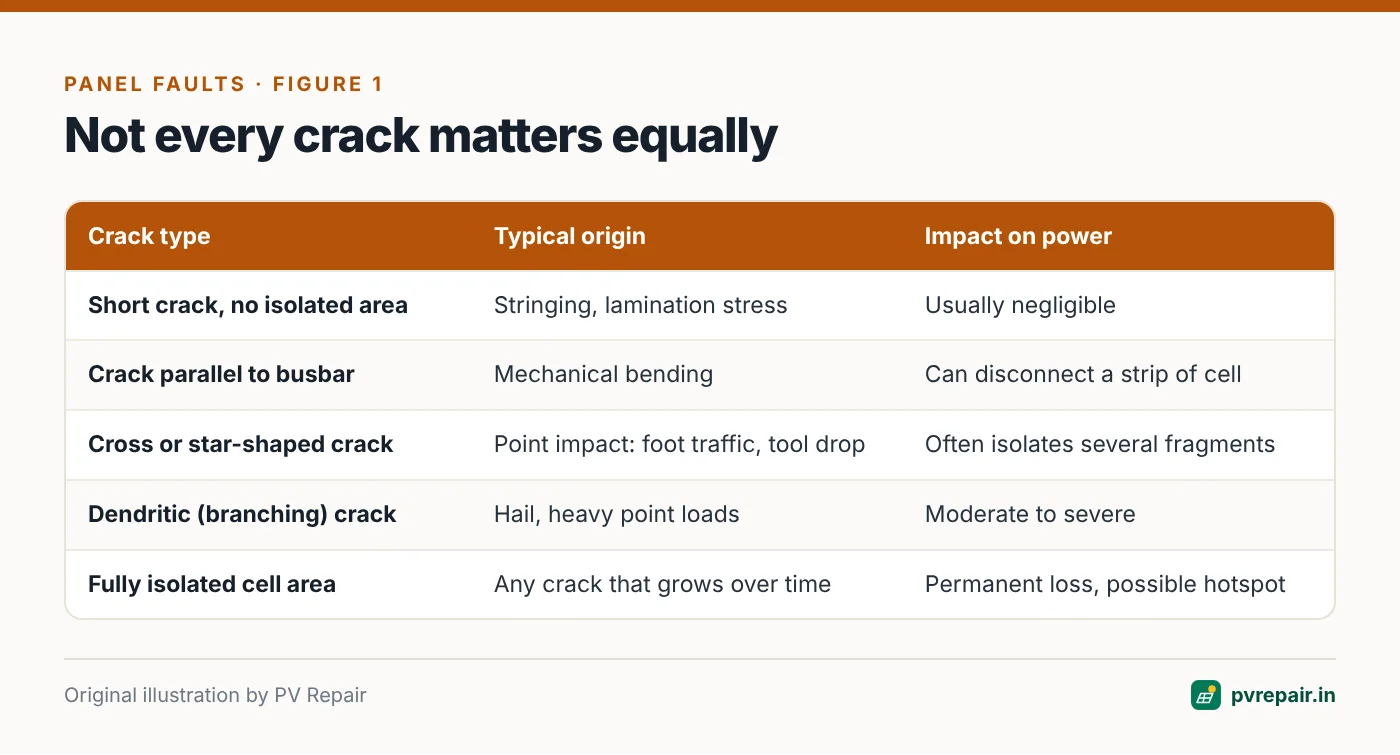
Engineers classify cracks by their orientation and whether they isolate part of a cell:
- Cracks that don't isolate any area — for example, a short crack across a busbar — may have little or no effect on power.
- Cracks parallel to busbars can be more harmful because they can disconnect a strip of cell from the busbar.
- Cross-shaped or dendritic (branching) cracks often come from point impacts like foot traffic or hail, and can isolate several pieces.
- Cracks that fully isolate a cell area cause permanent power loss for that cell, and the cell may become a hotspot.
Modern multi-busbar and half-cut cell designs are more tolerant of cracks than older designs, because current has more paths to reach a busbar.
What snail trails are
Snail trails are discolorations that appear on the front of cells, typically months to a few years after installation. They look like thin, dark or silvery lines, often branching like the trails left by snails.
The widely accepted explanation is chemical: moisture and oxygen diffuse through the backsheet and into the encapsulant, and reach the silver paste used for the cell's front contacts via the crack. Additives in the encapsulant and the silver react, forming silver compounds that discolour along the crack. That's why snail trails are such a useful visual clue — they "draw" the crack pattern on the cell.
Snail trails are a symptom, not the disease
The discolouration itself has only a small direct effect on output. What matters is the crack underneath it. Some snail-trailed modules perform well within warranty; others have significant losses. Measure before deciding.
How to detect microcracks
Visual inspection
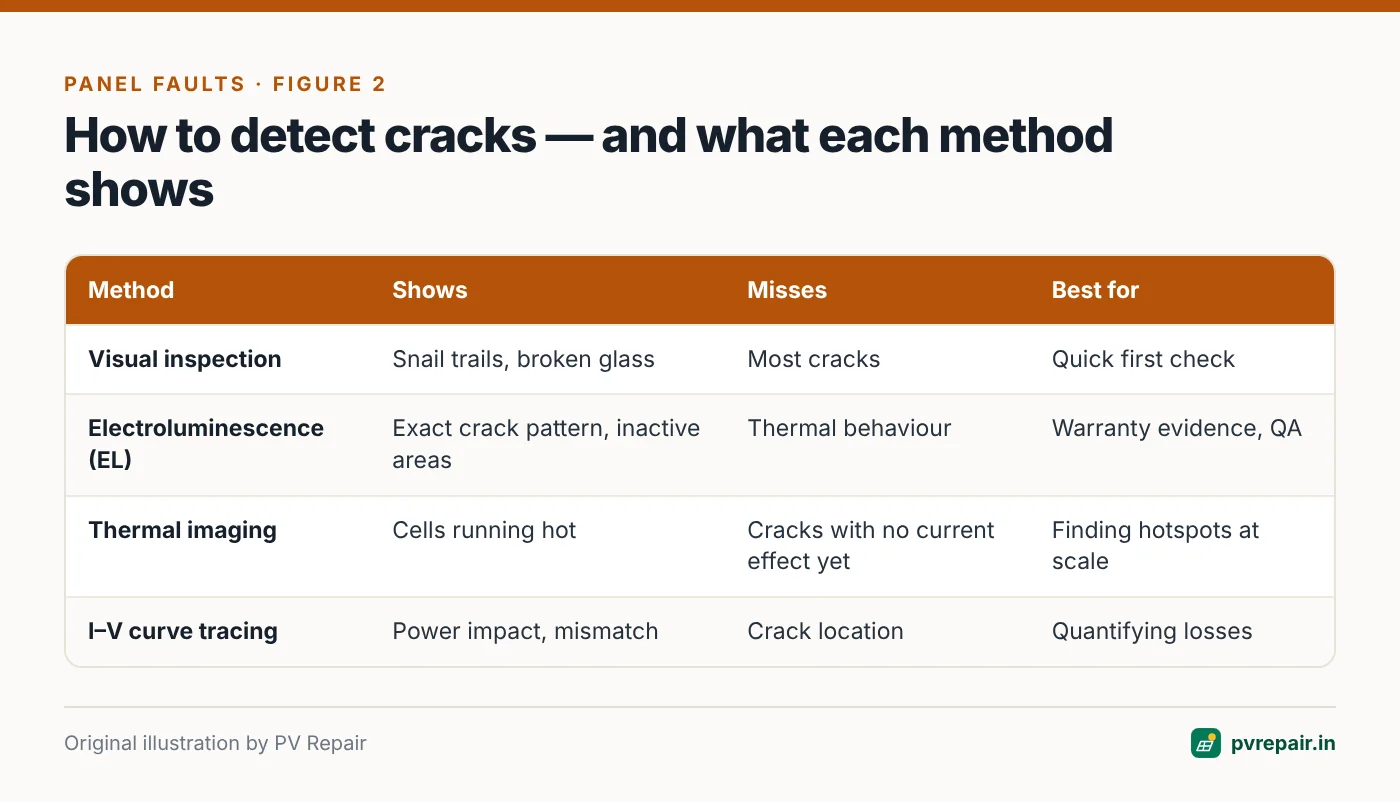
Look at modules from different angles in good daylight. Snail trails are often visible from a short distance. Visual inspection can't detect cracks without snail trails, but it's free and quick.
Electroluminescence (EL) imaging
EL imaging is the gold standard. The module is fed a current in forward bias (like an LED), and silicon emits faint near-infrared light. A special camera captures this emission in darkness. Cracked and inactive areas appear dark against the bright cells, revealing the exact crack pattern.
EL is typically done at night or under a dark tent, and portable EL systems now allow on-site testing of installed modules. EL images are compelling evidence for warranty and transport damage claims.
Thermal imaging
Severely cracked cells with isolated areas may show as warmer cells under operating conditions. Thermal imaging won't show cracks that don't yet affect current, so it can miss early damage. See hotspots.
I–V curve tracing
I–V curves show the electrical effect — reduced current, mismatch steps or lower fill factor — but not the location of cracks. Useful for quantifying the impact on a string or module.
Do microcracks reduce power?
It depends on the crack type, how much cell area is isolated, and how cracks grow over time. Studies of field modules show a wide range: many modules with minor cracks perform within normal degradation, while modules with large isolated areas can lose several percent of power, sometimes more as cracks grow with thermal cycling.
The practical approach is to measure:
- Compare string or module output with similar, unaffected modules on the same system.
- Use I–V tracing on suspect modules if available, corrected to STC.
- Compare with the warranted power for the module's age (e.g., most warranties guarantee a certain percentage of nameplate power after 10, 25 or 30 years).
Warranty and claims
Microcracks from manufacturing defects may be covered under the module's product warranty, and power loss below the warranted level may be covered by the performance warranty. Transport damage is typically the responsibility of the supplier or carrier — which is why inspecting deliveries carefully, and ideally EL-testing samples on arrival for larger projects, is so valuable.
Cracks caused by installation, handling, foot traffic or extreme weather are generally not covered by the manufacturer, though they may be covered by insurance in the case of hail or storms.
To support a claim:
- Record module serial numbers and installation dates.
- Provide EL images, thermal images and I–V measurements.
- Show evidence of correct handling (installation photos, method statements).
- Report promptly — many warranties require timely notification.
Repair options
There's no reliable field repair for cracked cells. Options are:
- Leave in place and monitor if the power impact is small and there are no hotspots.
- Replace modules with significant power loss or hotspots.
- Claim under warranty, transport insurance or property insurance as appropriate.
Prevention
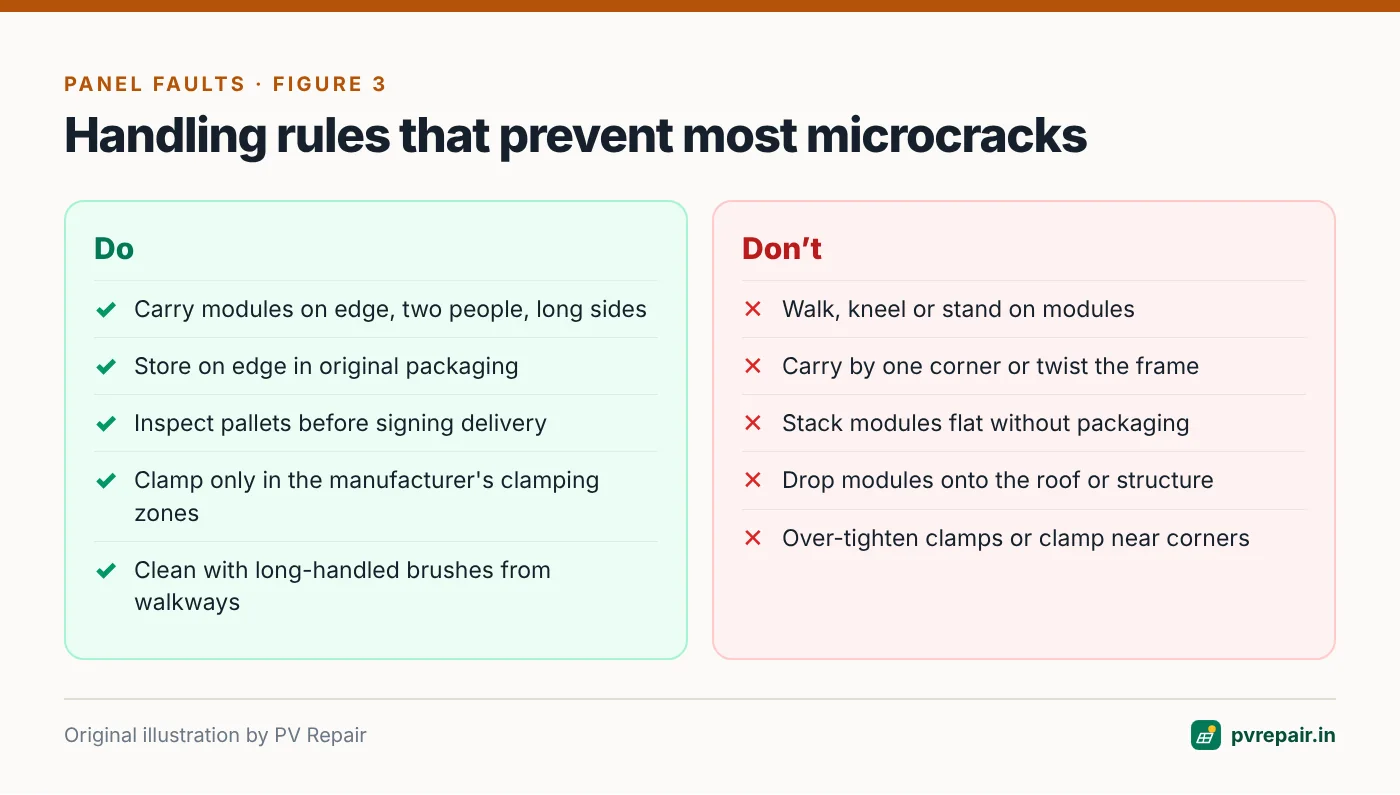
Most cracks are preventable:
- Handle modules on edge, carried by two people, gripping the long sides of the frame.
- Never walk on modules. Plan installation and cleaning access with walkways, ladders and gaps between rows.
- Store modules on edge in original packaging on firm, level ground, never stacked flat.
- Inspect deliveries for damaged pallets and packaging before signing for them.
- Use specified clamping zones and torque values from the module manual — clamping outside the zone flexes modules.
- Ensure cleaning crews use long-handled brushes rather than standing on modules.
Inspecting a delivery: a practical checklist
Many cracks are introduced before a module ever reaches the roof. A few minutes of checking at delivery can save a difficult argument later:
- Check pallets before unloading. Look for crushed corners, broken straps, pallets that have shifted, and packaging with puncture marks. Photograph any damage with the truck and the delivery note in the frame.
- Note damage on the delivery receipt before signing. "Received in good condition" makes later transport claims much harder.
- Open a damaged pallet in the presence of the driver if possible, and check the modules for broken glass and bent frames.
- Sample-test larger deliveries. For commercial projects, EL-testing a small random sample from each delivery establishes a baseline. If the sample shows cracking that wasn't in the factory EL images, you have strong evidence of transport damage.
- Keep the factory flash test and EL data that many manufacturers supply per serial number. They prove the module's condition when it left the factory.
Hail, storms and insurance
Hail is a growing concern in parts of India, with damaging storms reported in several states during pre-monsoon months. Hailstones can crack cells without breaking the glass, leaving a dense pattern of star-shaped cracks visible only under EL. After a significant hailstorm, compare generation with the days before the storm, and arrange an EL or thermal inspection if output has dropped. Hail and storm damage is typically a property insurance matter rather than a manufacturer warranty issue, so check whether your solar system is covered under your building or business policy, and keep the dated evidence.
Frequently Asked Questions
Are snail trails covered by warranty?
Snail trails on their own are often treated as cosmetic by manufacturers. If they're associated with power loss below the warranted level, a performance warranty claim may be possible. Measure the module's actual output and document cracks with EL imaging.
Can I see microcracks with my eyes?
Usually not, unless they've developed snail trails or are severe. Electroluminescence imaging is needed to see them reliably.
Do microcracks get worse over time?
They can. Daily thermal cycling and mechanical loads from wind can extend cracks and isolate more cell area. That's why some modules show increasing losses over years.
Can walking on solar panels damage them?
Yes. Walking on modules is one of the most common causes of microcracks, even if the glass doesn't break. Use walkways or clean from the edges with long-handled tools.
Should I EL-test a new installation?
For larger commercial and utility projects, EL testing a sample of modules on delivery and after installation is good practice and gives strong evidence if problems arise later.
Related guides
Delamination, Backsheet Cracks and Broken Glass: Can a Damaged Solar Panel Be Repaired?
How to recognise delamination, backsheet cracking, chalking and broken glass on solar modules, why each one is a safety and performance risk, and which repair options are realistic versus when replacement is the only safe choice.
Potential Induced Degradation (PID) in Solar Panels: Detection, Recovery and Prevention
What PID is, why it affects modules near the negative end of a string in hot, humid climates, how to recognise the pattern in data and EL images, and how anti-PID devices and design choices can recover and prevent losses.

Burnt Junction Box on a Solar Panel: Causes, Risks and Safe Repair Options
Why solar panel junction boxes overheat, melt and burn, how to spot the early warning signs, what to do immediately when you find one, and whether a junction box can be repaired or the module must be replaced.