DC Arc Faults in Solar Systems: Warning Signs, Detection and Prevention
What DC arcs are, why they're more dangerous than AC arcs, the difference between series and parallel arcs, how arc fault detection (AFCI) works in inverters, and the installation practices that prevent arcing.
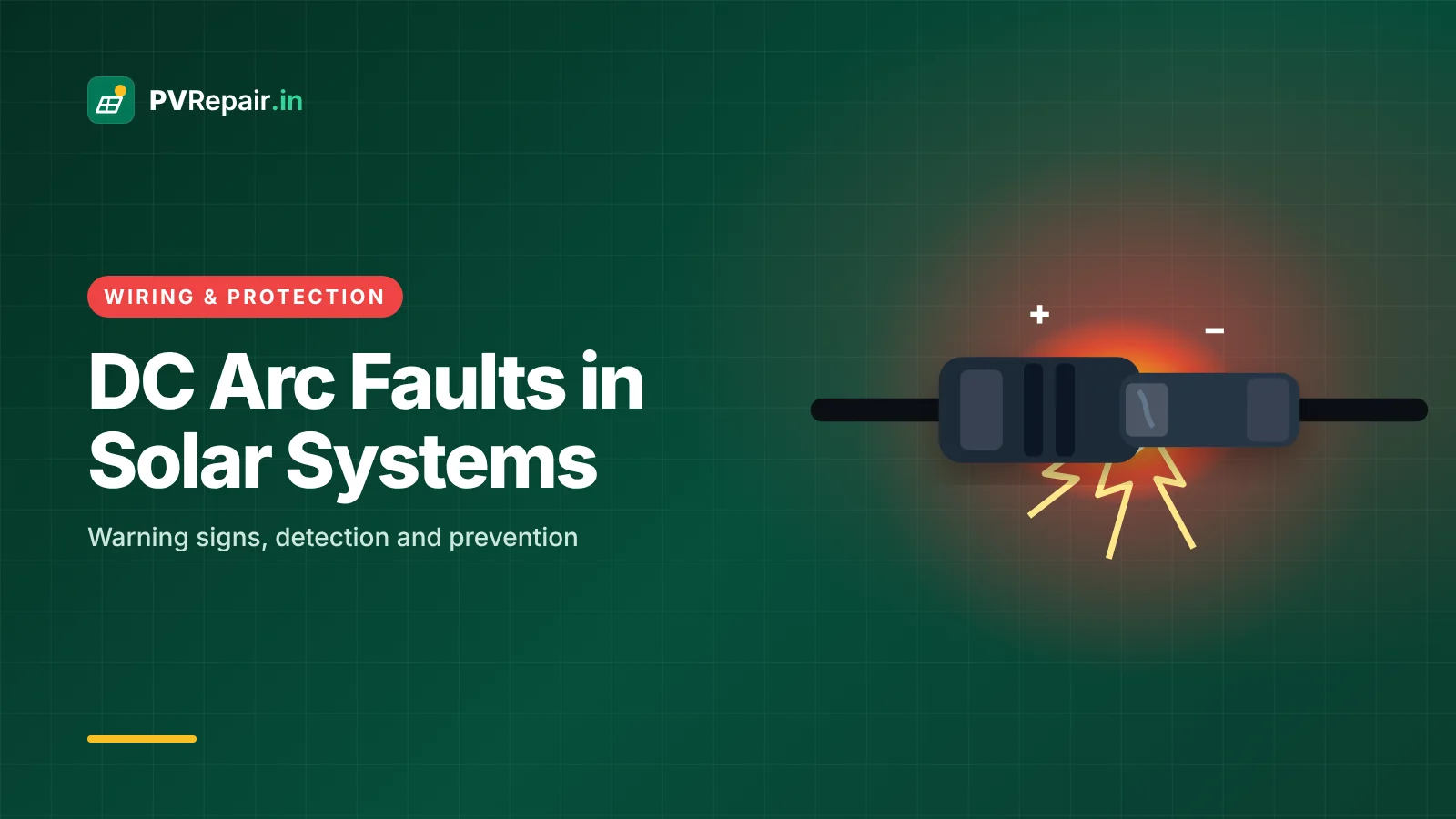
A DC arc is an electrical discharge that jumps across a gap in a circuit carrying direct current. In a solar array, arcs most often start at a loose or failed connection: a badly crimped connector, a loose terminal, a cracked solder joint in a junction box, or damaged insulation between two conductors. Because PV strings can operate at several hundred to 1500 volts and the array keeps supplying current as long as light falls on it, a DC arc can be sustained for a long time, reach thousands of degrees, and ignite nearby materials.
Arc faults are one of the main causes of the rare but serious fires associated with PV systems. The good news is that they're almost entirely preventable with good installation practice, and modern inverters can detect many arcs before they cause damage.
Quick answer
DC arcs occur at loose, damaged or poorly made connections (series arcs) or where insulation fails between conductors at different potentials (parallel arcs). Unlike AC, DC current has no zero-crossing, so arcs don't self-extinguish. Warning signs include burnt or melted connectors, discoloured terminals, a burning smell, intermittent string output and arc fault alarms on the inverter. Prevention relies on matched, properly crimped connectors, correct torque, cable protection and inverters with arc fault detection.
Why DC arcs are so dangerous
In an AC circuit, current passes through zero 100 times a second (at 50 Hz). Each zero-crossing gives an arc a chance to extinguish, which is why AC switches and breakers can interrupt current relatively easily. DC has no zero-crossing. Once a DC arc forms and the gap is small enough, it can sustain itself as long as the source supplies enough voltage and current.
A PV string is an ideal arc source: high voltage, current limited by sunlight rather than by a fuse that will blow, and no way to switch it off at the modules. Even when the inverter stops, the string voltage remains. That's why "turn it off" isn't enough to stop an existing arc on the array side — current only stops if the circuit is opened at the right place, or the light goes away.
Types of DC arcs
Series arcs
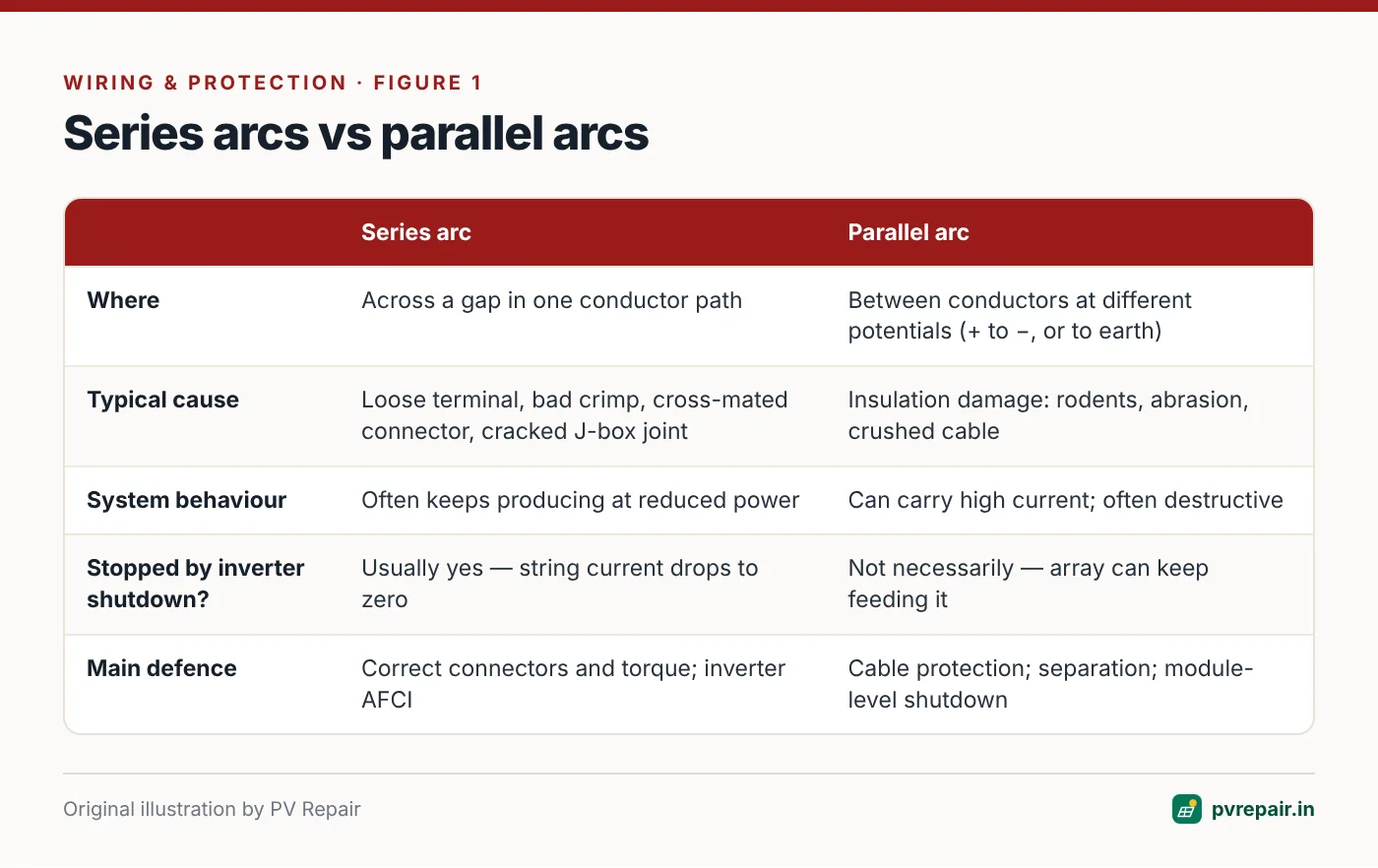
A series arc occurs within a single conductor path — at a connection that has opened slightly or degraded. Current flows through the arc in series with the load. Typical locations:
- MC4-type connectors that are cross-mated, poorly crimped or partially disconnected (see MC4 connector failures).
- Loose screw terminals in combiner boxes, DC isolators and inverter inputs.
- Cracked solder joints or ribbon connections in junction boxes (see burnt junction boxes).
- Broken conductors within a cable.
Series arcs are the most common type in PV. Because current still flows through the arc, the system may keep producing (somewhat reduced) power, which is why series arcs can persist unnoticed.
Parallel arcs
A parallel arc occurs between two conductors at different potentials — for example, between the positive and negative conductors, or between a conductor and earth — where insulation has failed. Causes include rodent damage, abrasion, crushed cables and degraded insulation. Parallel arcs can carry high current and are often more destructive. Ground faults that turn into arcs are a known fire mechanism.
Warning signs
- Arc fault alarms on the inverter (Arc Fault, AFCI Fault, Arc Detected). Many inverters lock out after an arc fault and need a manual reset.
- Melted, burnt or discoloured connectors, terminals or isolators.
- A burning or acrid smell around the array or combiner box.
- Crackling or buzzing noises near DC equipment.
- Intermittent string output — a string's current dropping out and returning.
- Thermal imaging hotspots at connections.
- Scorch marks on cable trays, roofing or module backsheets.
If you suspect an active arc
Keep people away. Switch off the inverter and the DC isolator if it can be done safely from a distance — but remember this does not stop current on the array side if the arc is between the array and the isolator. Do not attempt to pull apart connectors near an arc. If there is smoke or fire, evacuate and call the fire service, telling them it's a solar PV system with live DC conductors.
How arc fault detection works
Arc fault circuit interrupters (AFCI) or arc fault detection (AFD) built into inverters monitor the DC current for the electrical "noise" characteristic of an arc — a broadband high-frequency signature superimposed on the normal current. When the inverter detects this signature, it stops operating, which stops current flowing in a series arc (since the string current drops to zero when the inverter opens the circuit), and raises an alarm.
Key points:
- Series arcs are the main target of most inverter AFCI functions, because interrupting the current extinguishes them.
- Parallel arcs may not be extinguished by stopping the inverter, because the arc has its own path. Module-level shutdown devices or a disconnect close to the array help here.
- The international standard for PV arc fault detection is IEC 63027. In the US, NEC 690.11 has long required arc fault protection for PV systems, and many inverters sold globally include the function.
- Nuisance trips are possible from electrical noise, long cable runs or certain optimiser configurations. Firmware updates often refine detection algorithms.
Responding to an arc fault alarm
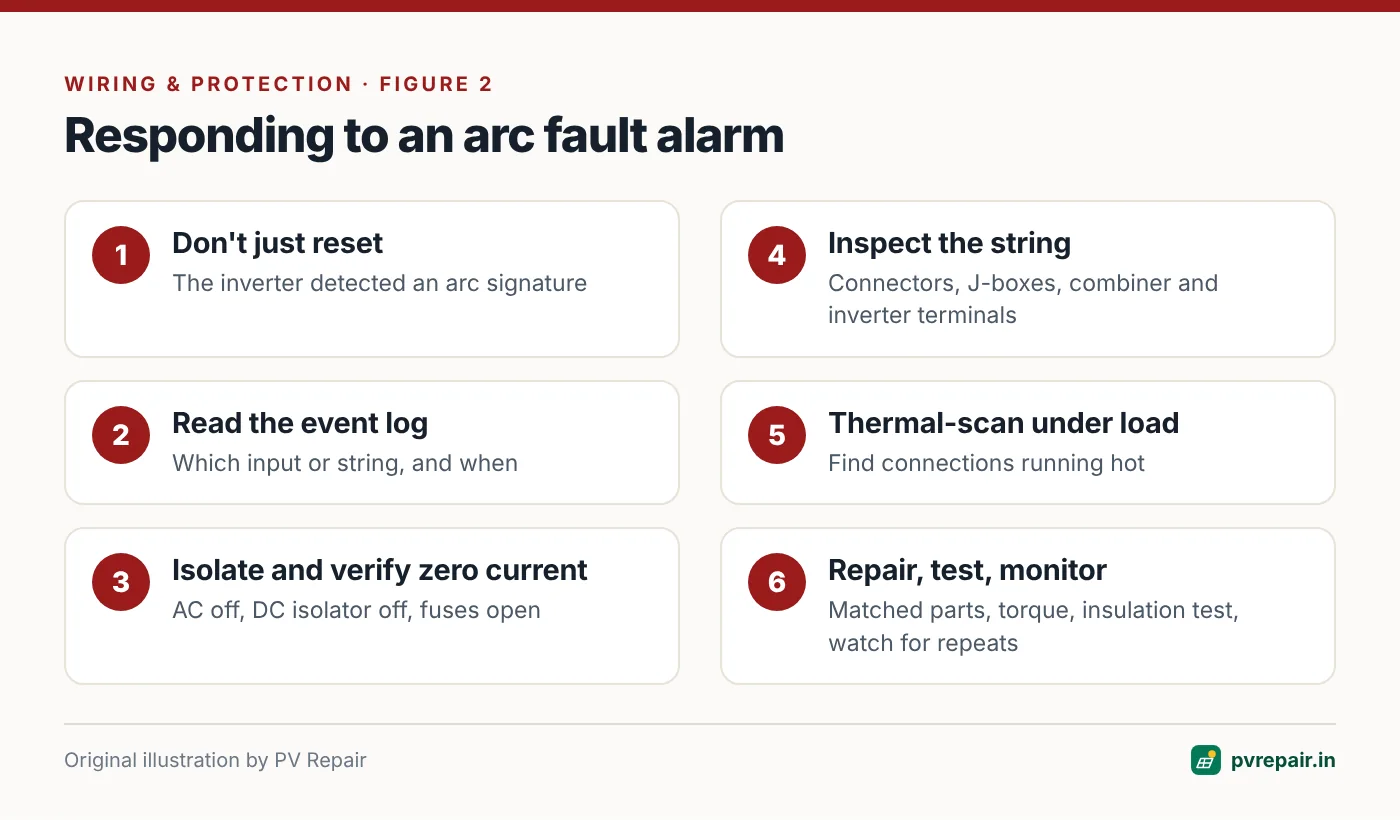
- Don't simply reset and walk away. An arc fault alarm means the inverter detected an arc signature. Find out why.
- Read the event log for which input or string triggered the alarm, and the time.
- Isolate the system (AC, then DC isolator, open string fuses) and verify no current is flowing.
- Inspect the identified string — connectors, junction boxes, combiner box terminals and the inverter's DC input connectors. Look for discolouration, melting and corrosion.
- Thermal-scan the string under load (after making sure it's safe to restart) to find connections running hot.
- Repair with matched components and correct crimping and torque. Replace any heat-damaged component.
- Test insulation resistance and Voc before returning to service. See string testing.
- Monitor closely for repeat alarms.
Prevention
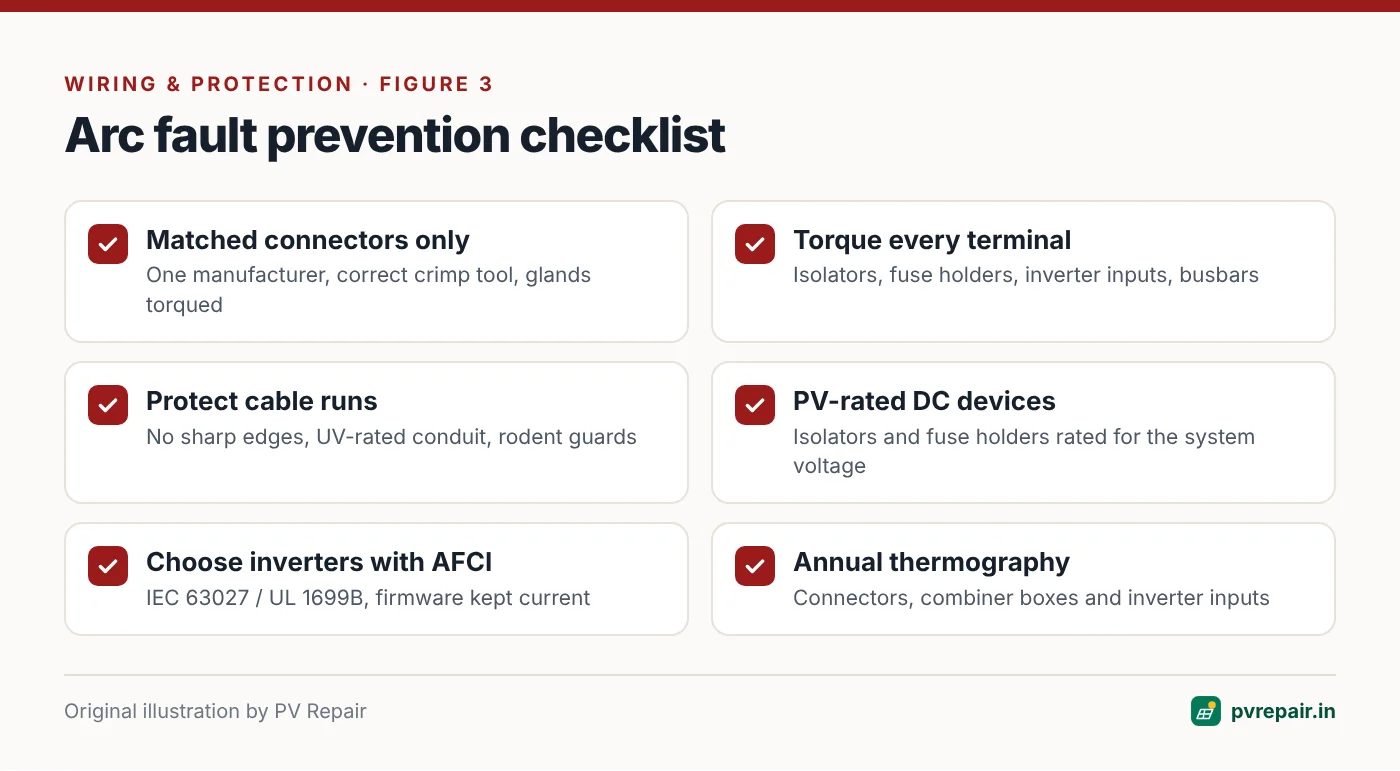
Almost every DC arc starts with a connection or insulation failure that could have been prevented:
- Connectors: use matched connectors from one manufacturer, crimped with the specified tool, fully locked and with glands torqued. Never cross-mate.
- Terminals: tighten every screw terminal (isolators, fuse holders, inverter inputs, combiner busbars) to the specified torque, and re-check during maintenance. Use ferrules where specified on fine-stranded conductors.
- Cable protection: protect cables from abrasion, sharp edges, UV and animals; support them so they don't hang on connectors. See our rodent damage guide.
- Separation: keep positive and negative conductors physically separated where practical inside enclosures to reduce parallel arc risk.
- Quality components: use DC isolators and fuse holders rated for PV DC duty at the system voltage.
- Inverters with AFCI: choose inverters with arc fault detection, keep firmware updated, and act on every alarm.
- Module-level shutdown: in some applications, module-level power electronics reduce array voltage when the system is shut down, improving safety for firefighters and maintenance.
- Thermography: annual thermal imaging of connectors, combiner boxes and inverter inputs catches deteriorating connections before they arc.
Where arcs happen most: a survey approach
If you're responsible for many sites, it pays to look for arc risk systematically rather than waiting for alarms. In field inspections, the highest-risk points are consistently:
- Field-made connector pairs, especially where a field connector meets a module's factory connector from a different brand.
- The inverter's DC input connectors, which carry the most current and are often made in a hurry at the end of an installation.
- Combiner box and DC isolator terminals, particularly in enclosures exposed to sun and large daily temperature swings.
- Junction boxes on older or low-quality modules.
- Cable runs crossing sharp edges or accessible to animals.
A half-day survey on a commercial rooftop — thermal imaging under good irradiance, a torque check of every accessible terminal, and a visual check of every field connector pair — finds most developing problems long before they become arcs.
Information for building owners and firefighters
Make it easy for anyone responding to an emergency to understand the system:
- Label the main DC isolator and AC isolator clearly, and put a site plan near the main electrical panel showing where DC cables run through the building.
- Mark DC cable routes inside the building with "Solar DC — live in daylight" labels at regular intervals.
- Keep emergency contact details for the installer or O&M provider at the main panel.
- If your system has module-level rapid shutdown, label the shutdown initiator clearly.
These simple steps help firefighters work safely and reduce damage if anything does go wrong.
Frequently Asked Questions
What causes DC arc faults in solar systems?
Mostly loose or poorly made connections (series arcs) and insulation damage between conductors (parallel arcs). Cross-mated or badly crimped connectors are a leading cause.
Will switching off the inverter stop a DC arc?
For a series arc in the string, stopping the inverter usually stops current and extinguishes the arc. For a parallel arc, or an arc between the array and the isolator, the array can keep feeding it in daylight. Isolate as close to the array as possible and keep away.
Do all solar inverters have arc fault protection?
No. Many modern inverters include AFCI, especially models also sold in markets where it's required, but not all do. Check the datasheet for "AFCI" or "arc fault detection" and compliance with IEC 63027 or UL 1699B.
Can I reset an arc fault alarm myself?
You can, but you shouldn't without investigating. An arc fault alarm means the inverter detected a potentially dangerous condition. Have a qualified technician inspect the system before resetting.
Can arc faults cause solar panel fires?
Yes. DC arcs are one of the main causes of PV-related fires. That's why prevention through correct installation, and detection through AFCI and inspection, are so important.
Related guides
Rodent, Monkey and Bird Damage to Solar Cables: Prevention and Repair
How rats, squirrels, monkeys and pigeons damage rooftop solar systems in India, the faults they cause, and proven prevention methods — conduit, cable trays, mesh skirts and bird deterrents — plus safe repair of chewed cables.
Solar Earthing and Lightning Protection: Common Mistakes and How to Fix Them
The earthing and lightning protection mistakes most often found on Indian solar rooftops — unbonded frames, shared or high-resistance earth pits, long SPD leads, missing separation distances — and how to correct each one.
Blown DC Fuses and Failed Surge Protection Devices in Solar Combiner Boxes
Why string fuses blow and SPDs fail in solar DC combiner boxes, how to size gPV fuses correctly, how to read SPD status indicators, and how to replace both safely without creating new problems.