Potential Induced Degradation (PID) in Solar Panels: Detection, Recovery and Prevention
What PID is, why it affects modules near the negative end of a string in hot, humid climates, how to recognise the pattern in data and EL images, and how anti-PID devices and design choices can recover and prevent losses.
Potential Induced Degradation — PID — is a gradual loss of module power caused by a voltage difference between the solar cells and the earthed module frame. It's not a physical defect you can see. Modules look perfect. But over months or a few years, output from some modules declines, sometimes dramatically, and string performance falls.
PID was a major industry problem in the early 2010s, and module manufacturers have since improved materials to resist it. But it hasn't disappeared, especially in hot, humid climates like much of India, and on high-voltage systems. Crucially, some forms of PID are reversible if caught early. This guide explains how to recognise it, recover from it, and design to avoid it.
Quick answer
PID happens when cells sit at a large voltage relative to the earthed frame, driving ion migration through the glass and encapsulant that degrades cell performance. In p-type modules, it typically affects modules at the negative end of a string most severely. It's accelerated by heat, humidity and high system voltage. Signs include gradually falling output on some strings, lower Voc and fill factor, and a characteristic pattern of dark cells in EL images. The common reversible form (PID-s) can often be recovered with anti-PID offset devices that apply a reverse potential at night.
What causes PID
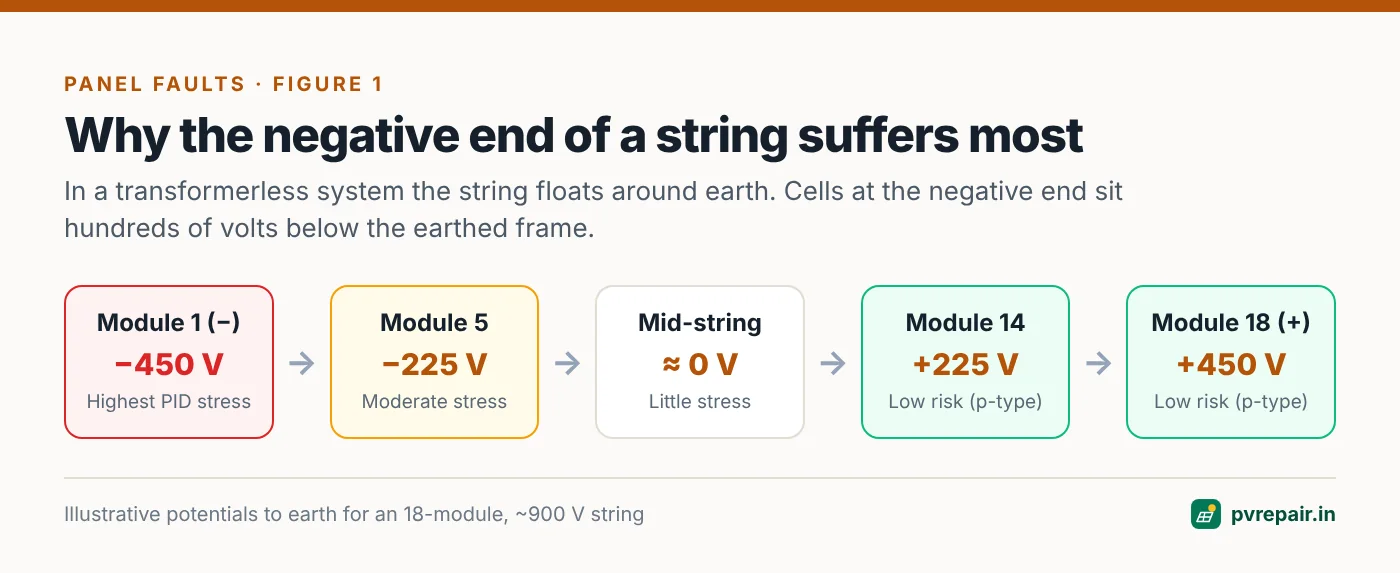
In a typical string, modules are connected in series, and the string's voltage is distributed along its length. In a transformerless inverter system, the string floats roughly symmetrically around earth potential: the positive end sits at a positive voltage relative to earth, and the negative end sits at a negative voltage. On a 1000 V system, the most negative module's cells may be several hundred volts below the earthed frame.
The module frame is earthed for safety. Between the cells and the frame are the glass and encapsulant, which aren't perfect insulators — especially when hot and humid. This voltage drives a small leakage current, and with it the migration of ions (sodium from the glass is the main culprit in the most common PID type) towards the cell surface. These ions accumulate at the cell's anti-reflective coating and junction, creating shunt paths that reduce the cell's ability to produce power.
Factors that accelerate PID
- High negative voltage relative to earth — so modules at the negative end of long strings, and high-voltage systems (1000–1500 V).
- Heat — ion mobility increases strongly with temperature.
- Humidity and moisture — moisture on the glass surface and in the encapsulant increases conductivity. Morning dew and monsoon months matter.
- Soiling — conductive dirt on the glass can extend the "earth" from the frame across the glass surface.
- Module materials — glass composition, encapsulant type and cell anti-reflective coatings determine susceptibility.
Types of PID
- PID-s (shunting): the most common type in p-type crystalline modules. Sodium ions create shunts in the cell. Largely reversible in its early stages.
- PID-p (polarisation): affects some high-efficiency n-type and rear-contact cells. Often reversible and sometimes recovers on its own when conditions change.
- PID-c (corrosion): electrochemical corrosion, mostly in thin-film modules. Not reversible.
How to recognise PID
In your monitoring data
- Gradual decline in output over months, rather than a sudden drop.
- Some strings degrade faster than others, especially longer strings or those on inverters with higher DC voltage.
- Within a string, the negative-end modules are worst — if you can measure module by module.
- Worse after hot, humid seasons.
In measurements
- Lower Voc and lower fill factor on affected modules, visible in I–V curves.
- Module-by-module comparison showing a gradient: modules at the negative end produce least, modules at the positive end are close to normal.
- Low-irradiance performance suffers first; PID-affected cells perform especially badly in morning and evening light.
In images
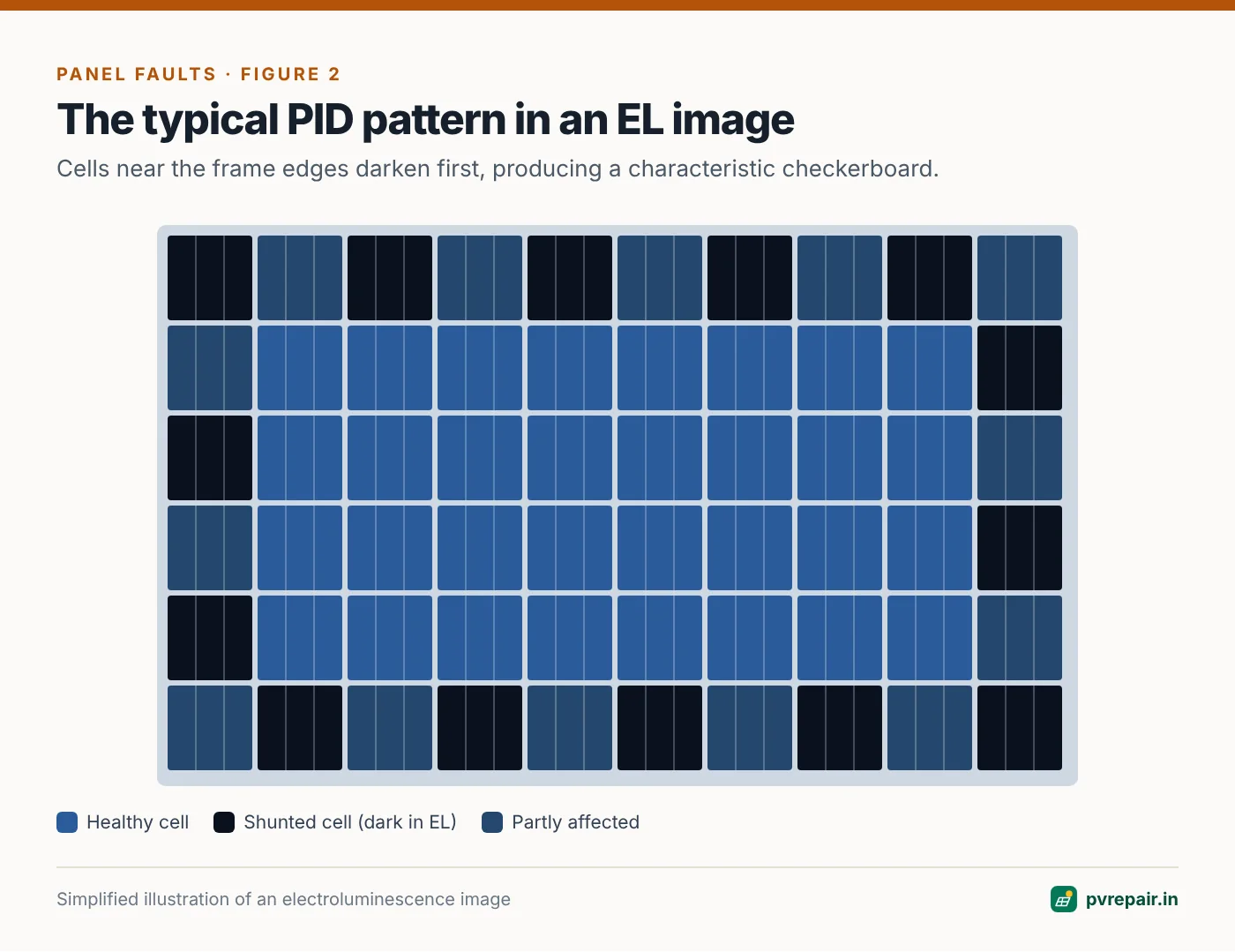
- Electroluminescence (EL) imaging shows a characteristic "checkerboard" pattern of dark cells, often starting at cells near the module frame edges.
- Thermal imaging may show warmer cells in a patchwork pattern in severely affected modules.
Recovery: can PID be reversed?
For PID-s, the most common form, yes — often substantially, if caught early.
Anti-PID offset boxes
These devices apply a voltage between the PV array and earth at night (when the array isn't producing), raising the array's potential so that the negative-end modules sit at a positive voltage relative to the frame. This reverses the ion migration and gradually restores cell performance over weeks to months. Some inverters have this function built in; others need an external device compatible with the inverter.
Inverter-based PID recovery
Some inverter manufacturers offer PID recovery modules or firmware functions that perform a similar night-time offset. Check what's available for your inverter.
Negative grounding (where permitted)
With transformer-based inverters, grounding the negative pole of the array keeps all cells at a positive potential relative to earth, preventing PID-s in p-type modules. This isn't possible with most transformerless inverters and has its own safety and design considerations.
Get the polarity right
Some cell technologies are affected by positive rather than negative potential. Using an anti-PID device or grounding configuration designed for the wrong technology can make things worse. Confirm the module manufacturer's recommendation before applying any PID countermeasure.
Replacing modules
Severely affected modules, or those with irreversible PID (such as corrosion types), may need replacement. Some degradation may also qualify for a performance warranty claim if output falls below warranted levels.
A worked diagnosis example
Consider a composite but typical case: a 100 kW rooftop plant on a factory near the coast, commissioned three years ago with p-type modules, transformerless string inverters and strings of 20 modules at around 1000 V maximum.
- Monitoring shows uneven decline. Specific yield has dropped about 6% compared with the first year, after correcting for irradiance. Three of the eight inverters are noticeably worse than the others.
- The worst inverters have the longest strings. Those three inverters were configured with 20-module strings, the others with 16-module strings. Higher string voltage means a more negative potential at the negative end.
- Module-by-module checks show a gradient. On a test string, the open-circuit voltage and the low-irradiance output of modules near the negative end are clearly lower than those near the positive end.
- EL imaging confirms the pattern. Night-time EL on a sample of negative-end modules shows the classic checkerboard of dark cells starting near the frame.
- Response. The owner fits anti-PID offset devices compatible with the inverters, after confirming with the module manufacturer that a positive offset is appropriate for the cell technology. Performance is tracked monthly. Over the following months, the gap between the affected and unaffected inverters narrows steadily.
The key lessons: string-level and module-level comparisons do most of the diagnostic work, and early action recovers more.
PID and Indian operating conditions
Many Indian sites combine the conditions that accelerate PID: high module temperatures for much of the year, high humidity during the monsoon, heavy morning dew in winter in many regions, and coastal or industrial soiling that can be slightly conductive. Commercial and industrial rooftops increasingly use 1000 V or 1500 V string designs to reduce cable and inverter costs, which raises the voltage at the negative end of strings.
None of this means PID is inevitable — modern PID-resistant modules perform well in these conditions — but it does mean PID resistance should be a procurement requirement rather than an afterthought, and that string-level performance should be watched from the first year.
Are anti-PID devices worth it?
For residential systems with short, low-voltage strings and PID-resistant modules, a dedicated anti-PID device is rarely necessary. For larger commercial plants, especially high-voltage designs in hot and humid locations, the cost of an inverter with an integrated anti-PID function — or an external offset device — is usually small compared with the value of even a 1–2% performance loss over many years. The decision is best made with the module manufacturer's guidance and data from the first year or two of operation.
Prevention
Choose PID-resistant modules
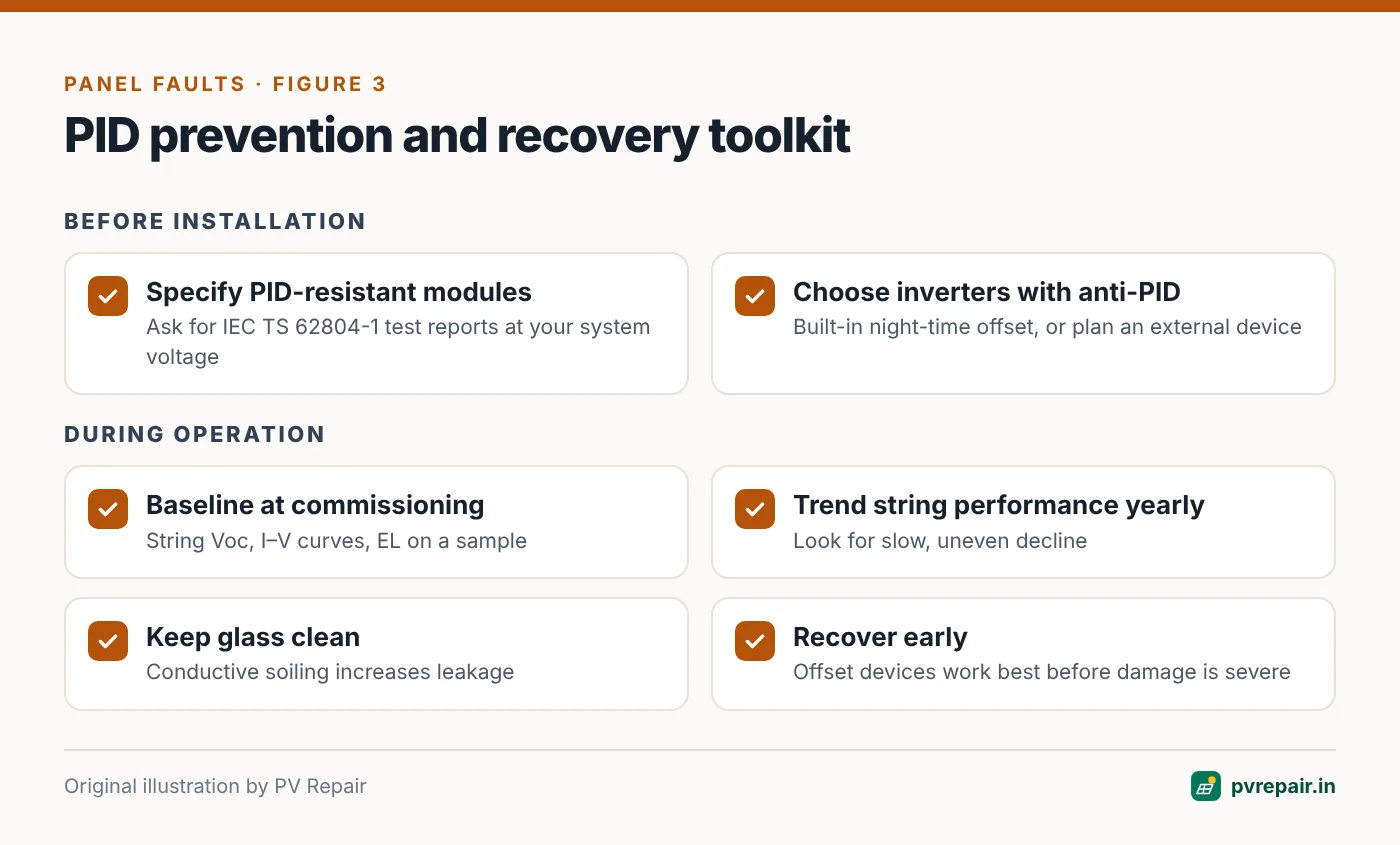
Most reputable manufacturers now test their modules for PID resistance using IEC TS 62804-1 (the standard test method for detecting PID in crystalline silicon modules). Ask for test reports showing minimal degradation under PID test conditions, ideally at the system voltage you'll use.
Use appropriate system design
- Avoid unnecessarily high string voltages if PID risk is high.
- Use inverters with built-in anti-PID functions, or plan for anti-PID devices on large plants in hot, humid locations.
- Ensure proper earthing and equipotential bonding of frames.
Keep modules clean
Conductive soiling and wet dirt can increase leakage across the glass. Regular, appropriate cleaning helps — see solar panel cleaning.
Monitor from day one
Commissioning measurements (string Voc, Isc, I–V curves and, ideally, EL images on a sample) give you a baseline. Comparing annually reveals PID trends early, when recovery is most effective. Include these in your annual maintenance checklist.
Frequently Asked Questions
Is PID still a problem with modern solar panels?
Less than it was, because most manufacturers now use PID-resistant materials and test to IEC TS 62804-1. But PID can still occur, especially in hot, humid climates, on high-voltage systems, or with lower-quality modules.
Which panels in a string are most affected by PID?
For the common PID-s in p-type modules, modules near the negative end of the string — those at the most negative potential relative to earth — are usually affected most.
Can PID damage be reversed?
PID-s and PID-p are often reversible, especially in early stages, using night-time potential offset devices. PID-c (corrosion) generally isn't reversible.
How long does PID recovery take?
It varies with severity, temperature and the device used. Many systems show measurable improvement within weeks, with recovery continuing over several months.
Does PID affect microinverter systems?
PID is driven by high voltage relative to earth. Microinverter systems operate each module at low voltage, so PID risk is generally much lower than in long, high-voltage strings.
Related guides
Delamination, Backsheet Cracks and Broken Glass: Can a Damaged Solar Panel Be Repaired?
How to recognise delamination, backsheet cracking, chalking and broken glass on solar modules, why each one is a safety and performance risk, and which repair options are realistic versus when replacement is the only safe choice.
Microcracks and Snail Trails in Solar Panels: What They Mean for Performance and Warranty
How microcracks form in solar cells, why snail trails appear along them, how electroluminescence and thermal imaging reveal cracks, and when cracked modules need replacing or a warranty claim.
Burnt Junction Box on a Solar Panel: Causes, Risks and Safe Repair Options
Why solar panel junction boxes overheat, melt and burn, how to spot the early warning signs, what to do immediately when you find one, and whether a junction box can be repaired or the module must be replaced.