Blown DC Fuses and Failed Surge Protection Devices in Solar Combiner Boxes
Why string fuses blow and SPDs fail in solar DC combiner boxes, how to size gPV fuses correctly, how to read SPD status indicators, and how to replace both safely without creating new problems.
Open a DC combiner box (or DCDB) on most commercial rooftops and you'll find two kinds of protection devices: string fuses in fuse holders, and a surge protection device (SPD). Both are meant to sit quietly for years. When one operates — a fuse blows, an SPD's indicator turns red — it's telling you something has happened on the DC side.
The mistake many technicians make is to simply replace the blown part and move on. A fuse that blew once will often blow again if the cause isn't found, and a failed SPD left in service provides no protection at all. This guide covers how both devices work, why they fail, how to size them correctly, and how to replace them safely.
Quick answer
String fuses protect modules and cables from reverse current when strings are connected in parallel. They blow because of a fault (short circuit, earth fault, reverse polarity) or because they were undersized, the wrong type, or overheated in a hot enclosure. SPDs divert surge energy from lightning and switching to earth; they fail after absorbing large or repeated surges, or from overvoltage if their rating is too low. Always find the cause, use gPV-rated fuses sized to the module datasheet, and replace SPDs with the correct voltage rating and type.
What string fuses do
When several strings are connected in parallel (in a combiner box, or on a single MPPT input with three or more strings), a fault in one string — for example, a short circuit — can cause current from all the other strings to flow backwards into it. Modules are only designed to withstand a limited reverse current, stated on the datasheet as the maximum series fuse rating. Beyond that, the module and its cables can overheat.
String fuses interrupt this reverse current. They're only needed when the possible reverse current exceeds what the modules can handle — typically when three or more strings are paralleled. Many residential systems with one or two strings per MPPT don't need string fuses at all.
Fuse type matters: gPV
PV fuses must be specifically designed to interrupt DC current at PV system voltages, with the low fault currents typical of PV arrays. Fuses marked gPV (to IEC 60269-6) are designed for this. Ordinary AC fuses, or DC fuses not rated for the voltage, may fail to interrupt a PV fault and can sustain an arc.
Sizing a string fuse
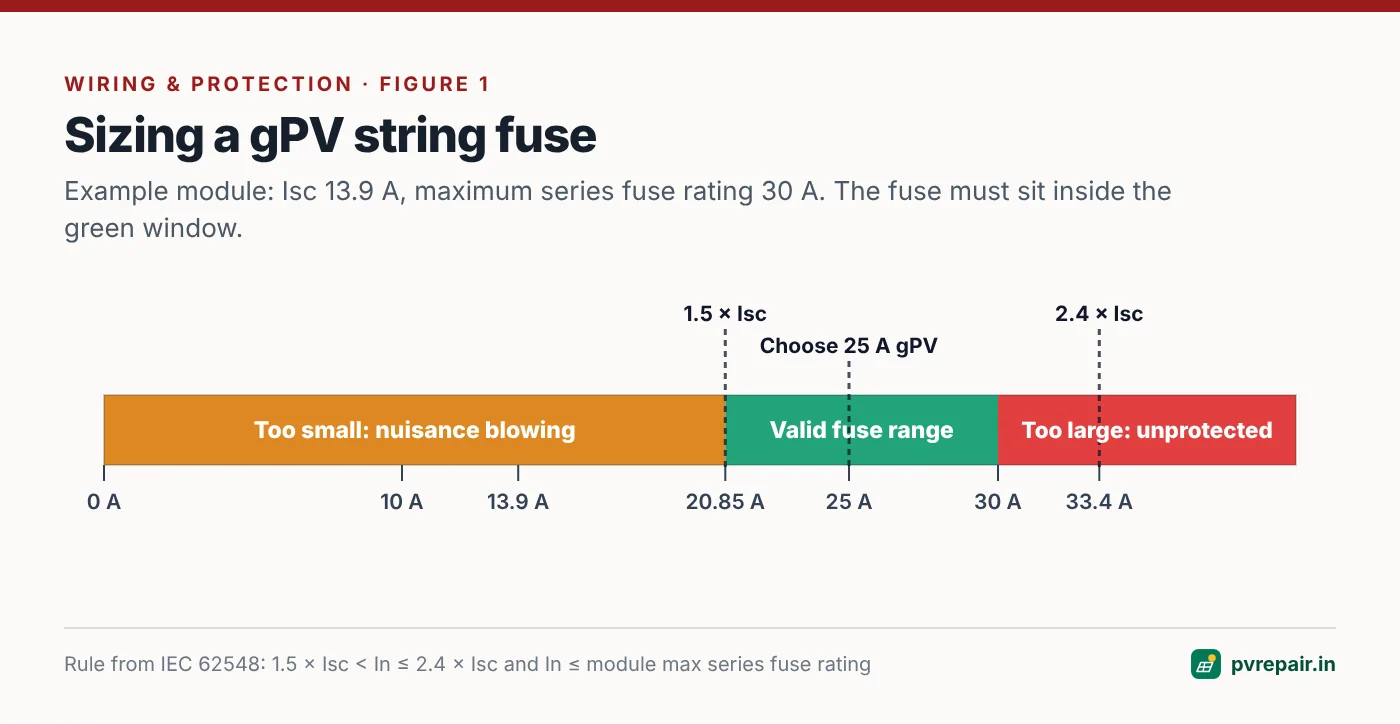
The commonly applied rule (from IEC 62548) is that the fuse rating must be:
- Greater than 1.5 × the module's Isc (to avoid nuisance blowing from normal high-irradiance current), and
- Not more than 2.4 × the module's Isc, and
- Not more than the module's maximum series fuse rating from the datasheet.
The fuse's voltage rating must exceed the maximum system voltage (cold-weather Voc).
With modern large-format and bifacial modules, Isc values of 13–18 A are common, which pushes fuse ratings upward. Bifacial gain increases current further, so designers must account for it. Undersized fuses are a common cause of nuisance blowing in summer.
Why string fuses blow
Genuine faults
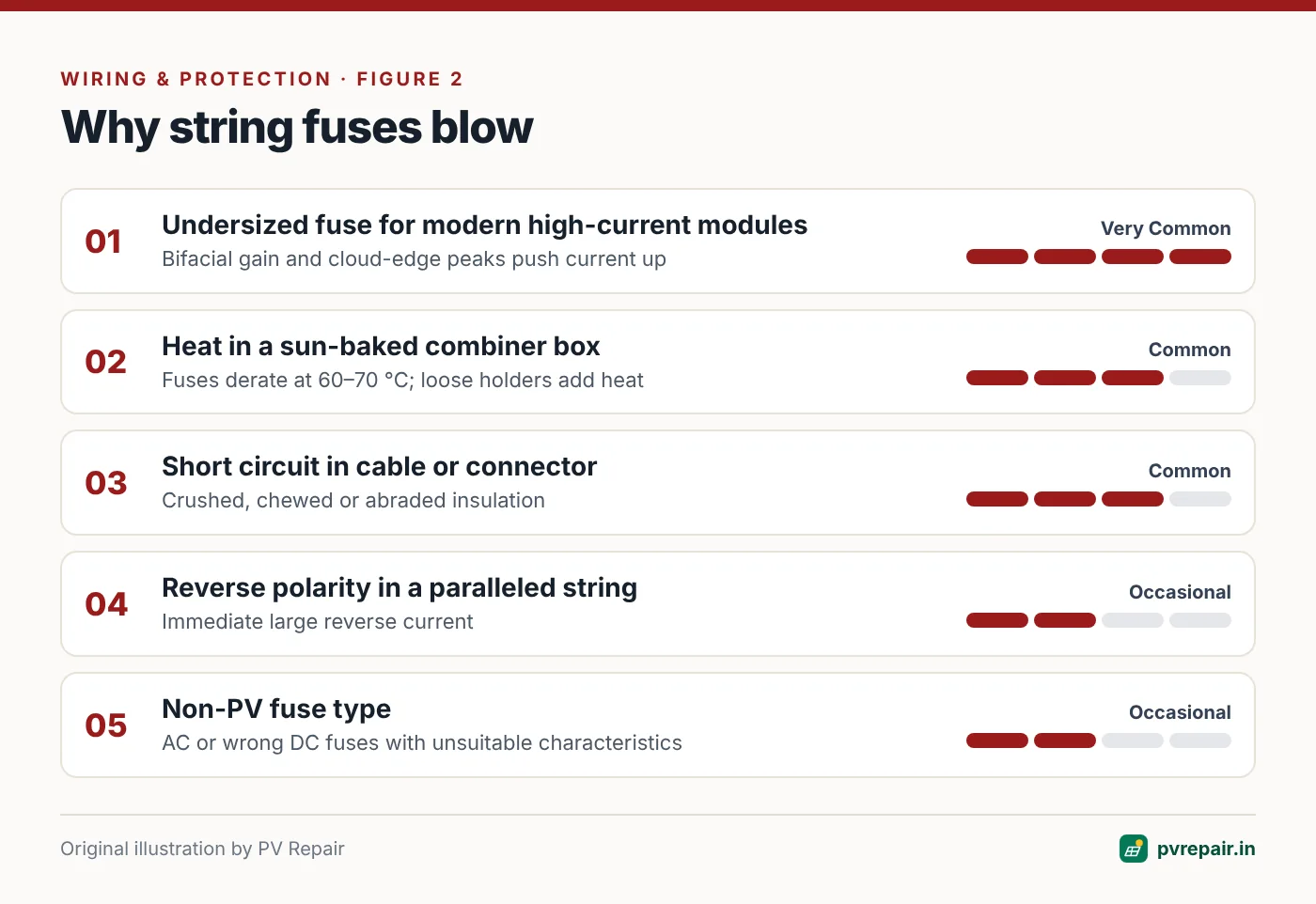
- Short circuits in cables or connectors — damaged insulation, crushed cables, rodent damage.
- Earth faults on certain system configurations.
- Reverse polarity — a string connected backwards in parallel with correctly connected strings creates a large reverse current immediately.
- Faulty modules with internal shorts.
Nuisance causes
- Undersized fuses, especially with high-current modules, bifacial gain or high-irradiance "cloud edge" events, which can briefly push current well above Isc at STC.
- Heat: fuses are thermally sensitive. In a sun-baked combiner box at 60–70 °C internal temperature, fuses derate and may blow at lower currents. Loose fuse holder contacts add local heating.
- Wrong fuse type: non-PV fuses with unsuitable characteristics.
- Ageing: repeated thermal cycling near the rating can fatigue the fuse element.
What SPDs do
Surge protection devices protect equipment from transient overvoltages caused by lightning (direct or nearby strikes induce surges in long cable runs) and switching events. A DC SPD typically contains metal oxide varistors (MOVs) or spark gaps connected between PV+, PV− and earth. Under normal voltage they don't conduct; during a surge they conduct briefly, diverting energy to earth and clamping the voltage.
Each SPD has a thermal disconnector that removes a failed or degraded MOV from the circuit, usually with a visible indicator — a window that changes from green to red, or a flag. Many SPDs have pluggable cartridges that can be replaced without replacing the base, and some have a remote signalling contact.
SPD ratings that matter
- Type: Type 1 (for direct lightning currents, where an external lightning protection system is present), Type 2 (for induced surges — most common on PV DC side), or combined Type 1+2.
- Maximum continuous operating voltage (Ucpv): must be above the maximum PV system voltage. A common guideline is at least 1.2 × the string Voc at STC; always verify against cold-weather Voc.
- Nominal discharge current (In) and maximum discharge current (Imax): how much surge energy it can handle.
- Voltage protection level (Up): the clamped voltage; must be below the withstand voltage of the protected equipment.
Why SPDs fail
- Large or repeated surges from lightning activity — the MOVs degrade with each significant surge until the thermal disconnector operates.
- Undersized Ucpv: if the SPD's continuous voltage rating is too close to or below cold-weather Voc, it conducts continuously, overheats and fails.
- Poor earthing: long or high-impedance earth connections reduce SPD effectiveness and increase stress. See earthing and lightning protection mistakes.
- Long connecting leads: SPD connection leads should be as short and straight as possible; long loops add inductive voltage during a surge.
- Ageing and heat in hot enclosures.
Inspection and replacement
Isolate before opening fuse holders
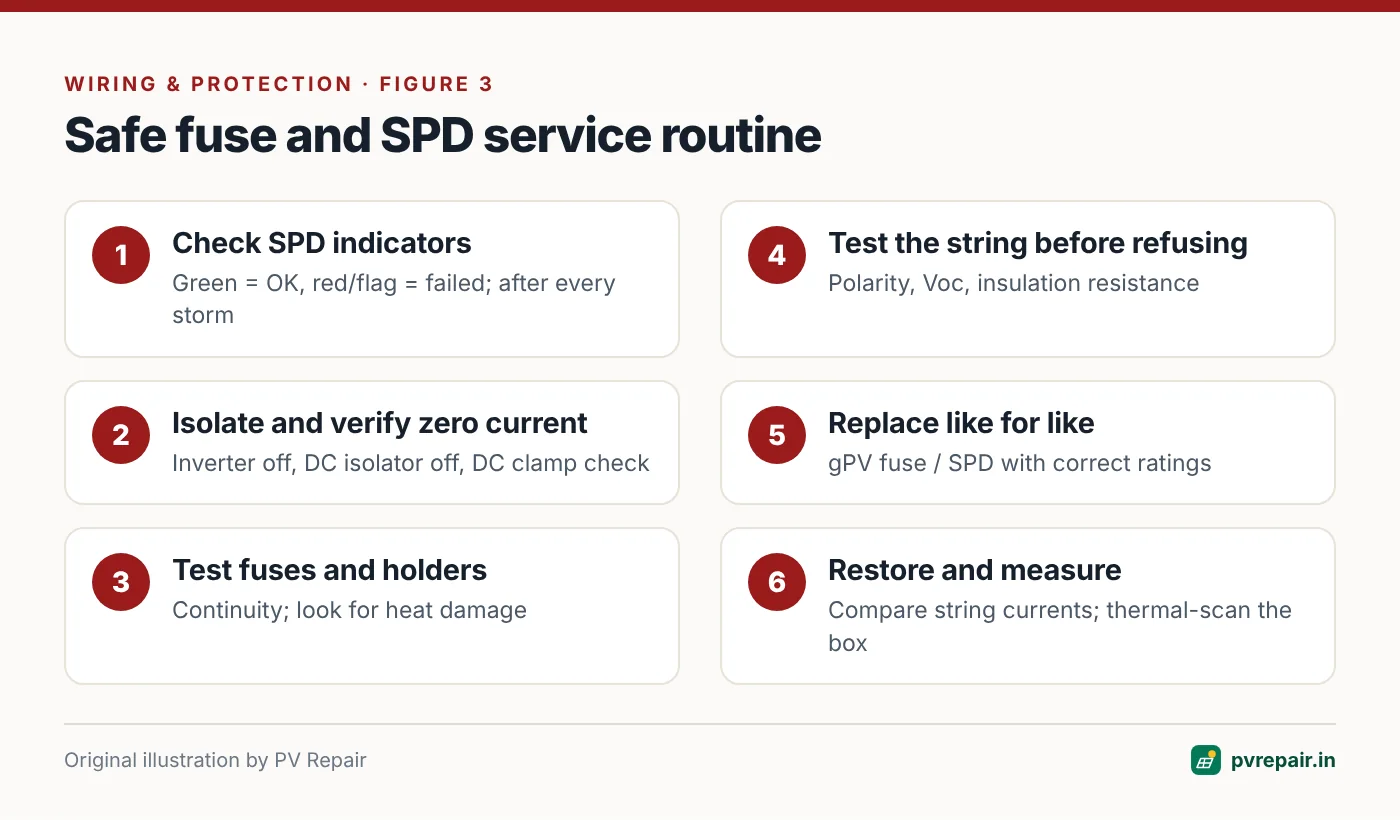
Fuse holders must never be opened under load. Switch off the inverter, open the DC isolator, and confirm with a DC clamp meter that no current is flowing in the string before opening any fuse holder. Remember that strings remain live in daylight.
Replacing a blown fuse
- Isolate as above.
- Open the fuse holder and test the fuse for continuity. Check the fuse holder contacts for discolouration or heat damage.
- Find the cause before replacing: test the string for polarity, Voc and insulation resistance (see our string testing guide). Inspect cables and connectors.
- Replace with a gPV fuse of the correct current and voltage rating, from a reputable manufacturer.
- Replace damaged fuse holders — a heat-damaged holder will cause the new fuse to overheat.
- Close the holder, restore the system and measure the string's operating current.
Replacing a failed SPD
- Check the indicator window on each SPD module during every maintenance visit, and after any thunderstorm.
- If an indicator shows failure, isolate the DC circuit and replace the cartridge (or the whole SPD) with the same type and ratings, or a correctly specified alternative.
- Check the SPD's earth connection — tight, short and connected to the main earthing system.
- If SPDs fail frequently, investigate earthing, the SPD's Ucpv rating and whether an external lightning protection system is needed.
A failed SPD may give no other sign
When an SPD's thermal disconnector operates, the system usually keeps working normally — it just has no surge protection. That's why visual checks of indicator windows (or remote signalling contacts connected to monitoring) are important.
Fuses, isolators and breakers: different jobs
It's easy to confuse the devices in a DC combiner box, but they do different jobs:
- gPV fuses protect against overcurrent and reverse current. They operate automatically and must be replaced after they blow.
- DC isolators (disconnect switches) let technicians switch off and isolate the DC circuit for maintenance. They must be rated for DC switching at the system voltage and current. An isolator isn't a protection device.
- DC circuit breakers combine overcurrent protection and switching, and can be reset. They're used in some designs instead of fuses, but must be specifically rated for PV DC duty and polarity.
- SPDs protect against transient overvoltages, not overcurrent.
Replacing one type with another — for example, an isolator where a fuse is needed, or an AC breaker on the DC side — creates hidden hazards. Always replace like for like or follow a revised design approved by a qualified engineer.
Combiner box heat: the hidden enemy
Many combiner boxes are mounted in direct sun on rooftops. Internal temperatures can reach 60–70 °C in summer. Fuses, fuse holders, SPDs and isolators are all temperature-sensitive. Shading combiner boxes, choosing light-coloured enclosures, leaving space for ventilation and following manufacturer derating guidance all reduce failures. Thermal imaging of combiner boxes under load is one of the most effective maintenance checks for finding loose connections and overheating fuse holders early.
Frequently Asked Questions
Why does my solar string fuse keep blowing?
Either there's a fault on the string (short circuit, reverse polarity, insulation damage), or the fuse is undersized, the wrong type, or overheating in a hot enclosure. Test the string and check the fuse rating against the module datasheet before replacing it again.
Do I need string fuses on my home solar system?
Often not. Fuses are generally only required when three or more strings are connected in parallel. Many residential systems with one or two strings per MPPT input don't need them. Follow your inverter manual and the design standard.
Can I use an AC fuse in a solar DC combiner box?
No. Use fuses rated gPV for the system voltage. AC fuses may not safely interrupt DC fault currents in PV systems.
How do I know if my SPD has failed?
Most SPDs have an indicator window that turns red, or a flag, when the protective element has disconnected. Some also have a remote signalling contact. Check them after storms and at every service.
Should I replace SPDs after a lightning strike?
Inspect them immediately after any nearby lightning activity and replace any that indicate failure. Also check other equipment, fuses and the inverter, and document the event for insurance.
Related guides
Rodent, Monkey and Bird Damage to Solar Cables: Prevention and Repair
How rats, squirrels, monkeys and pigeons damage rooftop solar systems in India, the faults they cause, and proven prevention methods — conduit, cable trays, mesh skirts and bird deterrents — plus safe repair of chewed cables.
DC Arc Faults in Solar Systems: Warning Signs, Detection and Prevention
What DC arcs are, why they're more dangerous than AC arcs, the difference between series and parallel arcs, how arc fault detection (AFCI) works in inverters, and the installation practices that prevent arcing.
Solar Earthing and Lightning Protection: Common Mistakes and How to Fix Them
The earthing and lightning protection mistakes most often found on Indian solar rooftops — unbonded frames, shared or high-resistance earth pits, long SPD leads, missing separation distances — and how to correct each one.