Grid Overvoltage and Undervoltage Trips on Solar Inverters: Why They Happen and How to Fix Them
Why grid-tie solar inverters trip on high or low grid voltage, how to tell whether the problem is your wiring or the DISCOM's supply, and the fixes that actually work in India.
You check your solar app at 1 p.m. on a bright day and see that the inverter has stopped and restarted a dozen times since 11 a.m. The event log shows Grid Overvoltage, AC Voltage High, Grid Voltage Out of Range or Vac High. Your neighbour's system on the same transformer does the same. This is one of the most common complaints from rooftop owners in India, and it is frequently misdiagnosed as a faulty inverter.
This guide explains why voltage trips happen, how to measure and isolate the cause, and what can realistically be done about it — by you, your installer, and your electricity distribution company (DISCOM).
Quick answer
Inverters must disconnect if the grid voltage at their terminals goes outside the limits set by the grid code. Overvoltage trips are usually caused by a combination of already-high grid voltage and voltage rise in an undersized AC cable between the inverter and the meter. Measure the voltage at the meter and at the inverter while it exports. If the difference is more than about 1–2%, upgrade the cable. If the grid is already high at the meter, the DISCOM must correct it.
Why inverters trip on voltage
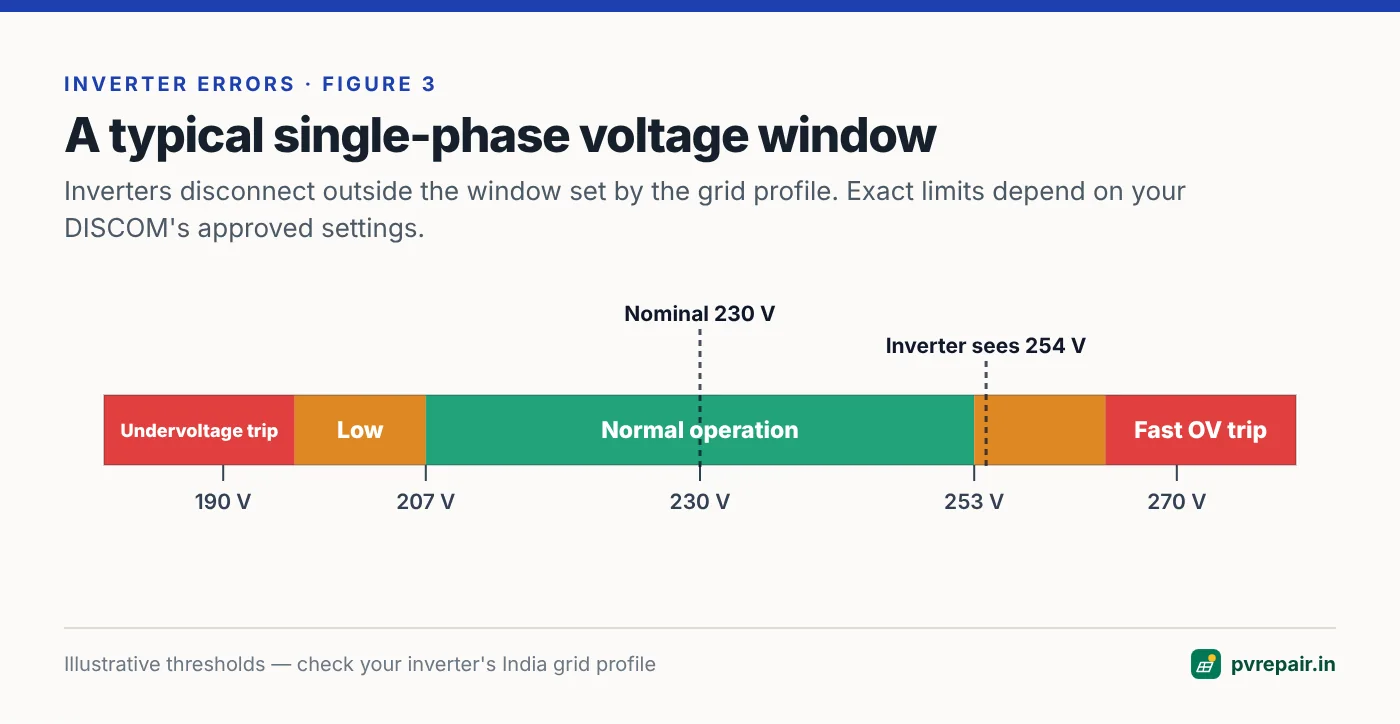
A grid-tie inverter is a current source synchronised to the grid. It is not allowed to "hold up" a grid that has gone outside normal limits, because that would be unsafe for line workers and other customers. Every inverter certified for grid connection in India therefore has protection settings that disconnect it if the voltage or frequency goes out of range for longer than a set time.
There are typically two overvoltage limits:
- A fast trip at a higher threshold, which disconnects within a fraction of a second to a couple of seconds.
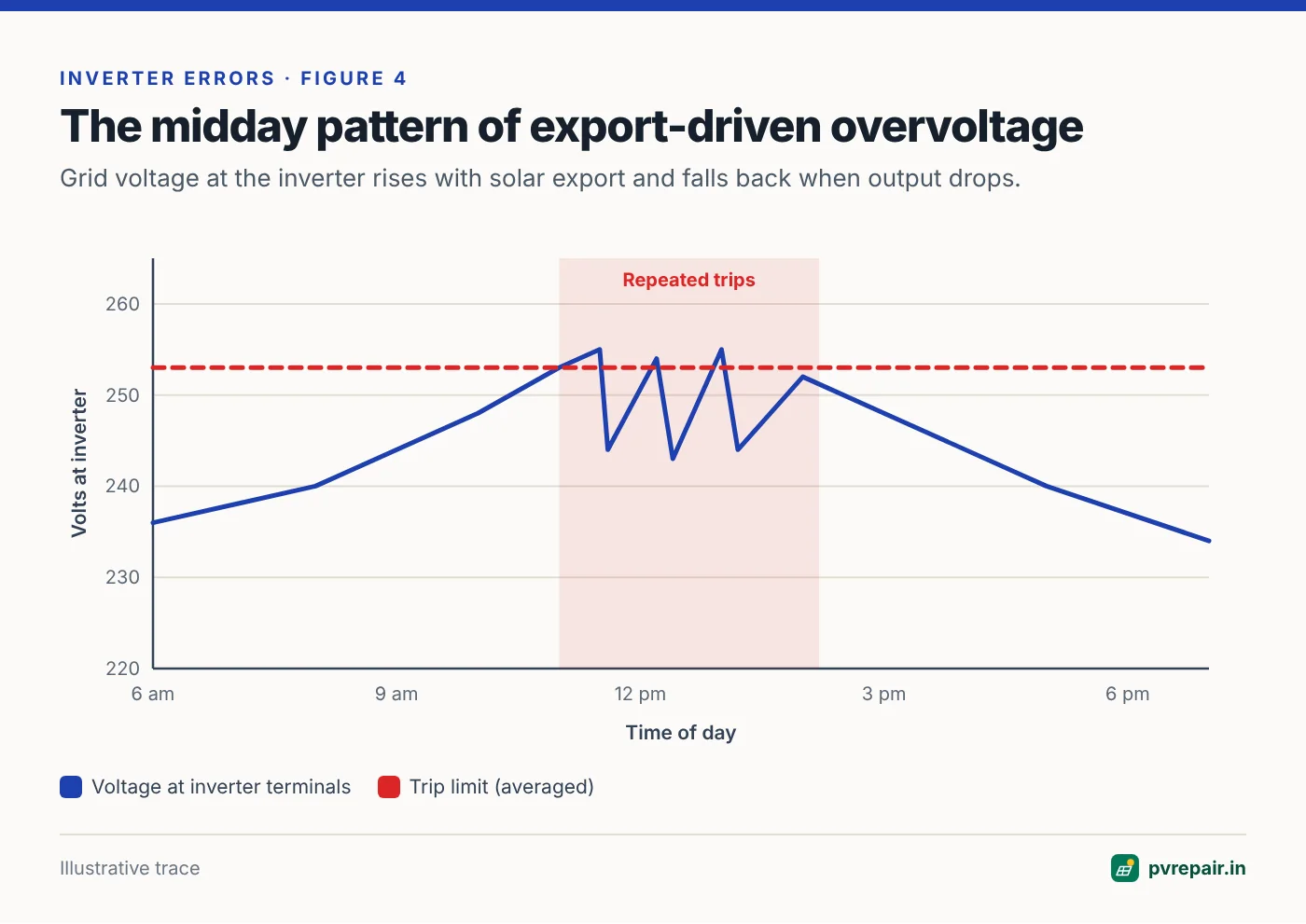
- A slower, averaged trip at a lower threshold, based on the average voltage over a period (often ten minutes in many grid codes). This is the one that catches systems sitting slightly high for long periods around midday.
Undervoltage works the same way in the other direction. The exact values are set by the grid connection regulations and the country or DISCOM profile selected in the inverter. For a 230 V single-phase system, typical overvoltage settings sit somewhere around 110–115% of nominal (roughly 253–265 V), but you must check the profile your inverter uses and what your DISCOM has approved.
Why voltage rises when your system exports
When your solar system exports power, current flows from the inverter out to the grid. Every metre of cable has resistance, and current through resistance causes a voltage difference (Ohm's law). For power to flow out, the voltage at the inverter must be higher than the voltage at the grid connection point.
That voltage difference is called voltage rise. It adds to whatever the grid voltage already is:
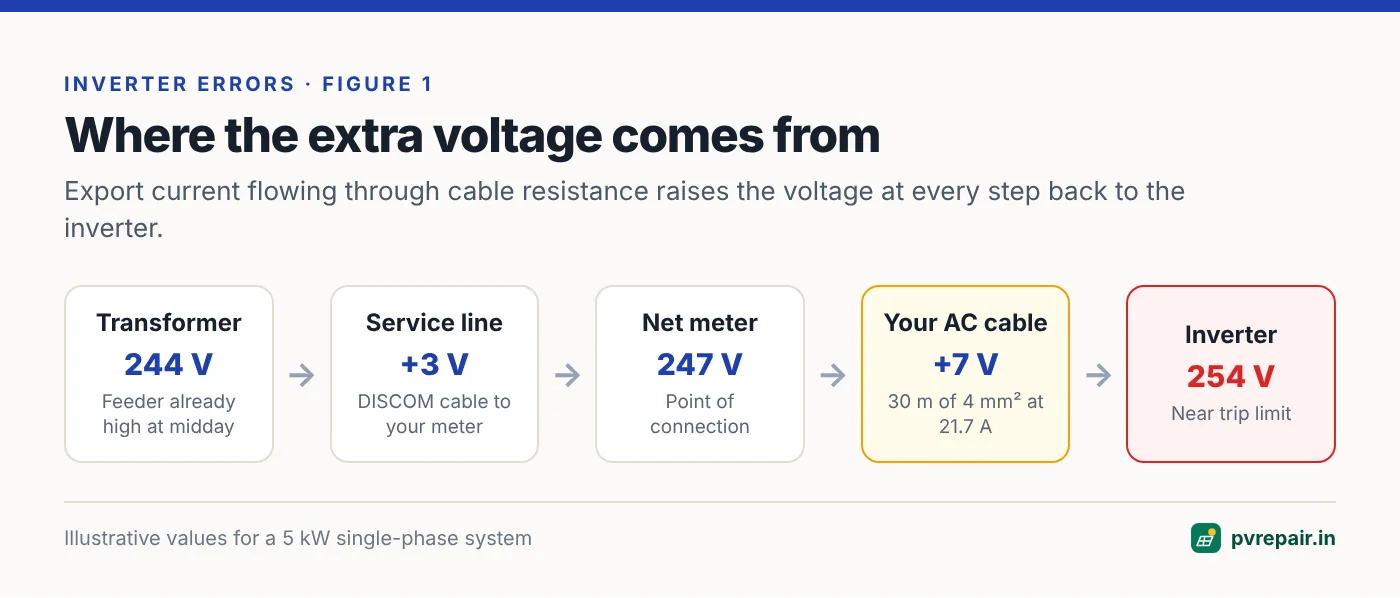
Voltage seen by inverter = Grid voltage at transformer + rise in DISCOM's service line + rise in your AC cable
On a lightly loaded feeder on a sunny day — lots of rooftop solar, few loads running — the grid voltage itself may already be at 245–250 V. If your AC cable adds another 5–8 V of rise, the inverter sees 255 V or more and starts tripping.
Worked example
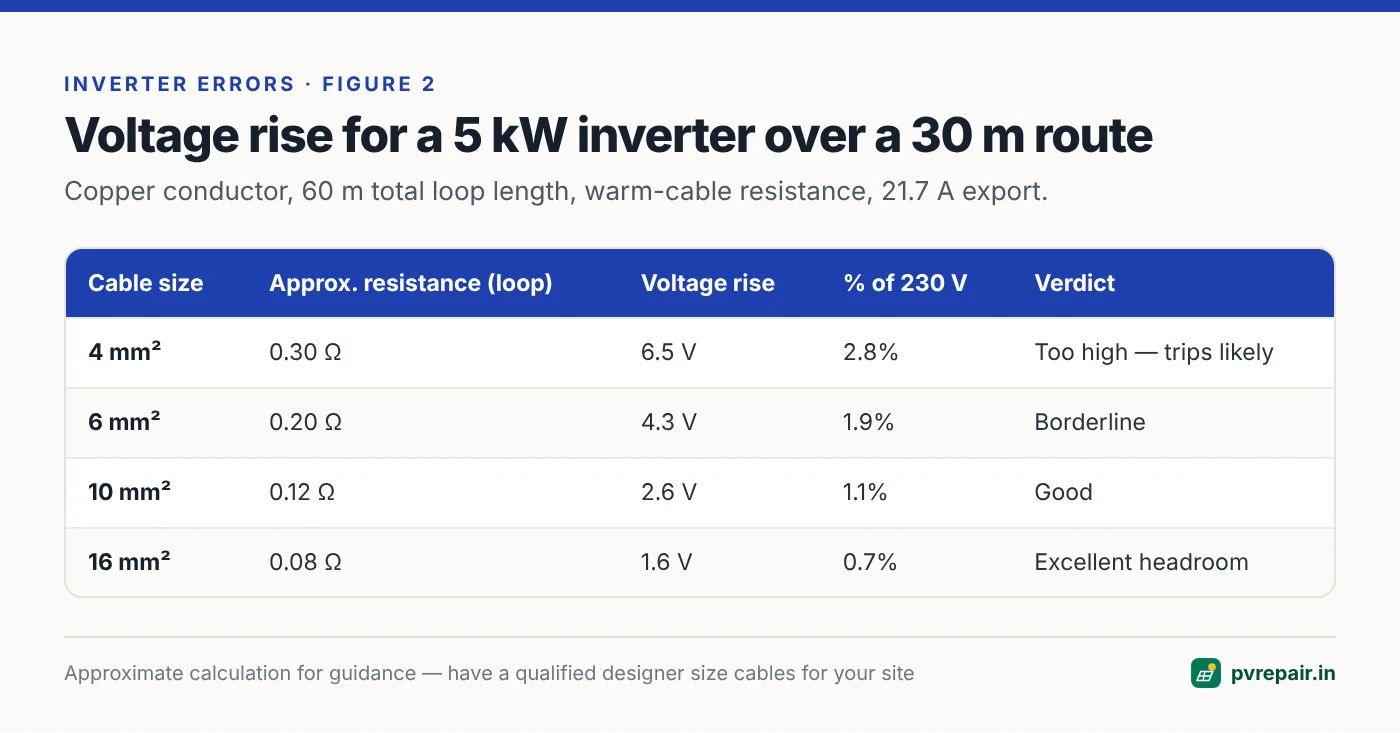
A 5 kW single-phase inverter exports about 21.7 A at full power. It is connected to the meter through 30 m of 4 mm² copper cable (route length, so 60 m of conductor including the neutral return).
- Resistance of 4 mm² copper ≈ 4.61 Ω/km at 20 °C, higher when warm. Use ~5.0 Ω/km on a hot roof.
- Total conductor length 60 m → 0.06 km × 5.0 = 0.30 Ω.
- Voltage rise = 21.7 A × 0.30 Ω ≈ 6.5 V, or about 2.8% of 230 V.
If the same run used 10 mm² cable (≈ 1.83 Ω/km, ~2.0 Ω/km warm), the rise would drop to about 2.6 V. A cable upgrade alone recovers about 4 V of headroom.
Good design target
Aim to keep voltage rise between the inverter and the point of connection at or below 1% where practical, and certainly not more than about 2%. Many rooftop systems are installed with the cable sized only for current-carrying capacity, which is not enough.
How to diagnose the problem properly
You need a true-RMS multimeter rated CAT III or higher, and ideally a voltage data logger. Work on AC distribution boards must be done by a licensed electrician.
Step 1: Read the inverter event log
Note the exact alarm and the time of day. Overvoltage trips clustered between 11 a.m. and 2 p.m. on sunny days point strongly to export-driven voltage rise. Trips at night or early morning when the inverter isn't generating mean the grid itself is high regardless of solar. Undervoltage trips in the evening peak point to a weak or overloaded feeder.
Many inverters also log the grid voltage they measured at the moment of the trip. Compare this with the nominal 230 V or 415 V.
Step 2: Measure at two points under export
With the inverter exporting at high power, measure:
- Voltage at the inverter AC terminals (or the AC isolator next to it).
- Voltage at the meter or the main incoming supply.
Then switch the inverter off and measure the meter voltage again.
| Measurement | Reading | What it tells you |
|---|---|---|
| Meter voltage, inverter off | 246 V | Grid voltage without your system |
| Meter voltage, inverter exporting | 249 V | Rise in DISCOM service line |
| Inverter terminals, exporting | 256 V | Rise in your own AC cable = 7 V |
In this example, 7 V of rise is within your own installation and is fixable by upgrading the AC cable or moving the inverter closer to the meter. The grid itself is at the high end but within limits.
Step 3: Log the voltage over several days
A single spot reading can mislead. Logging the grid voltage at the meter over a week (a plug-in voltage logger or a smart meter with interval data) shows whether the supply is persistently high. If the voltage at the meter sits above the statutory range for long periods even with the inverter off, the problem is on the DISCOM side.
Step 4: Check three-phase balance
On three-phase systems, check each phase. A single-phase inverter on an already high phase will trip while the others are fine. A three-phase installation with a loose neutral at the main board can produce one very high and one very low phase — this is dangerous and needs immediate attention.
Fixes that work
1. Reduce voltage rise in your installation
- Upgrade the AC cable from the inverter to the meter to a larger cross-section.
- Shorten the run by relocating the inverter closer to the main board.
- Tighten and inspect all terminations. A loose or corroded lug at an isolator, MCB or the meter adds resistance and creates local heating. Look for discolouration on terminals.
- Check the meter's service cable from the pole. If it's a long, undersized aluminium service cable, the DISCOM may need to replace it.
2. Use the inverter's grid-support functions
Most modern inverters have power quality response modes, if the DISCOM permits them:
- Volt-Watt: reduces active power output as voltage rises, rather than tripping completely. You lose a little generation at midday but avoid repeated full shutdowns.
- Volt-VAr / reactive power control: the inverter absorbs reactive power, which helps pull the local voltage down.
These must be configured according to the grid code and your DISCOM's approval. Do not change protection settings without authorisation.
3. Get the DISCOM to correct the supply
If the grid voltage at your meter is high with your inverter switched off, the remedy lies with the utility. In India you can lodge a complaint with your DISCOM's customer care, and escalate to the Consumer Grievance Redressal Forum (CGRF) if it isn't resolved. Supporting evidence helps: a week of voltage logs, inverter trip logs, and the names of neighbours with the same issue. Common DISCOM remedies include changing the distribution transformer tap, balancing load across phases, or upgrading the service line.
Never raise protection limits on your own
Widening the voltage trip limits beyond the approved country/DISCOM profile can breach your connection agreement, void certification and put line workers at risk. Some inverters lock these settings for exactly this reason. Only the installer, with DISCOM approval, should adjust them.
Undervoltage trips
Undervoltage trips usually happen in the evening or during high-demand periods, when the feeder is heavily loaded. They are often accompanied by poor voltage at your household loads — dim lights, struggling air conditioners. Causes include an overloaded transformer, a long rural feeder, a loose connection in your service line, or a phase imbalance. A loose neutral connection is a safety issue and should be checked immediately. Beyond that, the remedy is almost always on the DISCOM side.
Frequently Asked Questions
Is grid overvoltage damaging my solar inverter?
No — the trip is the inverter protecting itself and the grid. Repeated tripping causes wear on the AC relays over the long term and costs you generation, but the event itself is not damage.
Why does my inverter trip while my neighbour's doesn't?
Your AC cable may be longer or thinner, your inverter may be on a different phase, or you may be closer to the end of the feeder. Each installation sees slightly different voltage depending on its connection.
Will adding a battery stop overvoltage trips?
A hybrid system that stores midday energy instead of exporting it reduces export current and therefore voltage rise. It can help, but fixing undersized cabling is cheaper and should come first.
What grid voltage is normal in India?
Nominal low-voltage supply is 230 V single-phase and 415 V three-phase at 50 Hz. Supply regulations allow a permitted variation around nominal, so check your state electricity supply code. Persistent readings well above that range should be reported to your DISCOM.
Can I fix voltage trips by changing the inverter's country setting?
No. The country or grid profile must match the grid code you are connected under. Selecting a different country to get wider limits is non-compliant and unsafe.
Related guides
PV Overvoltage Error: When String Voltage Exceeds Your Inverter's Limit
Why PV overvoltage alarms appear on cold, bright mornings, how to calculate maximum string voltage with temperature correction, and how to fix an oversized string before it damages the inverter.
How to Read Solar Inverter Fault Codes: A Universal Guide for Any Brand
Inverter error codes look cryptic, but almost every brand groups them into the same handful of categories. Learn to decode any fault code, use the event log, and decide what you can check yourself.
Solar Inverter Not Turning On? A Systematic Diagnosis From Panels to Display
Blank screen, no LEDs or stuck on "Waiting"? Work through the DC supply, start-up voltage, isolators, fuses and internal faults in the right order to find why your solar inverter won't start.