Bypass Diode Failure in Solar Panels: Symptoms, Testing and Replacement
How bypass diodes protect solar modules, what happens when they fail short or open, how to spot a failed diode from string voltage and I-V curves, and when a diode can be replaced in the field.
Bypass diodes are small components inside a module's junction box, but they have a big job. They allow current to flow around a group of cells that is shaded or damaged, preventing that group from overheating and limiting the power lost from the whole string. When a bypass diode fails, a module can lose a third of its output permanently, or lose the protection that keeps hotspots in check.
This guide explains how bypass diodes work, the two ways they fail, how to identify a failed diode with measurements you can take on site, and what the repair options are.
Quick answer
Most modules have three bypass diodes, each protecting a third of the cells. A diode that fails short permanently bypasses its third of the module, so the module's voltage drops by about one-third and the string loses that power. A diode that fails open leaves its cells unprotected during shading, risking hotspots and backsheet burns. Diagnose with string and module Voc measurements, I–V curve tracing or thermal imaging. Diode replacement is possible on some junction boxes but usually means module replacement or a warranty claim.
How bypass diodes work
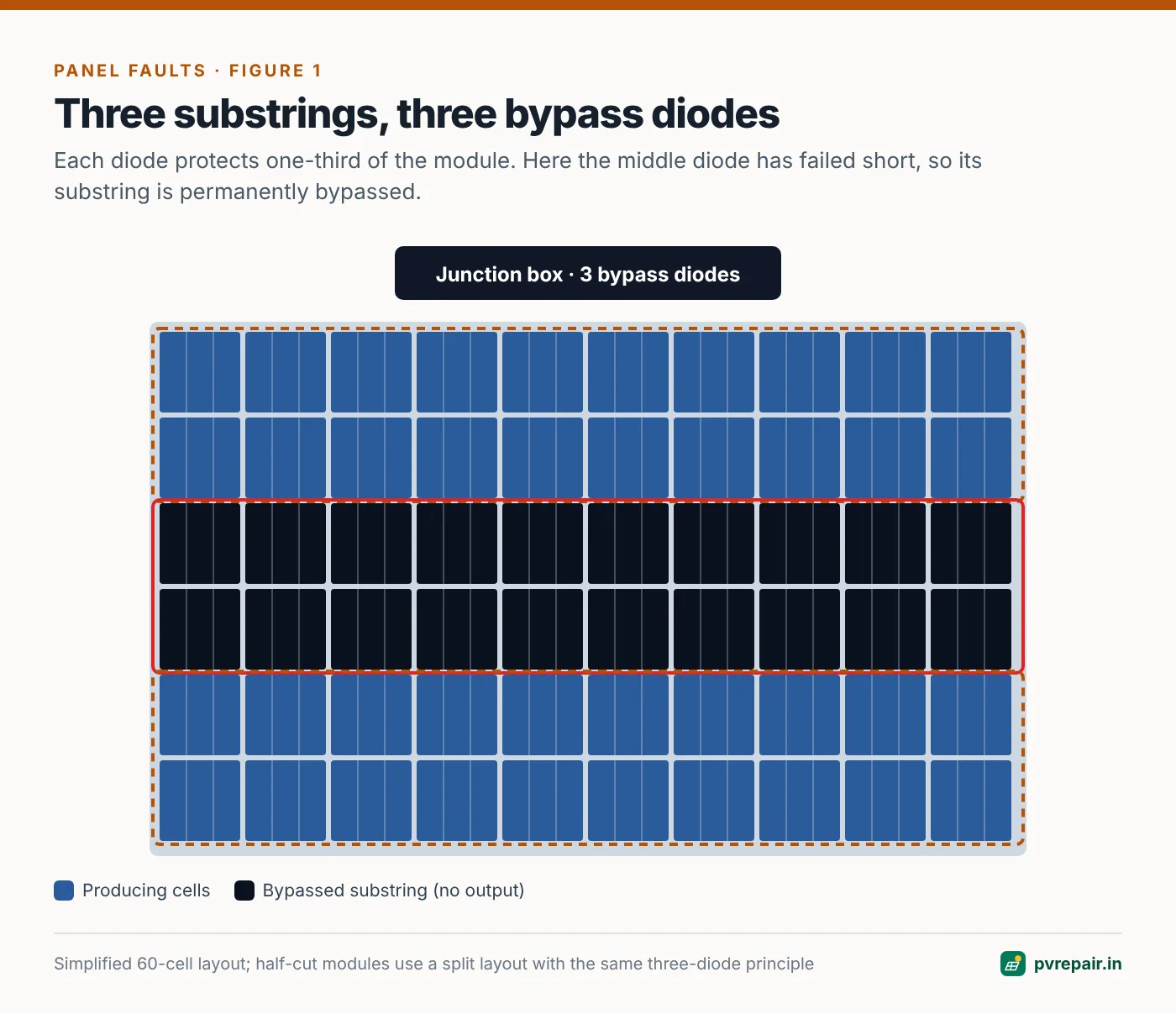
A typical 60-cell or 72-cell module — or the modern half-cut equivalents with 120 or 144 half-cells — is divided into three electrical sections, often called substrings. Each substring has a bypass diode connected in parallel with it, in the reverse direction, inside the junction box.
Under normal conditions, every cell produces current, the substring has a positive voltage across it, and the diode is reverse-biased: it does nothing. When part of a substring is shaded or damaged, that substring can't carry the string current. Its voltage collapses and, if pushed, becomes negative. Once the reverse voltage is enough to forward-bias the diode (a few tenths of a volt for the Schottky diodes commonly used), current flows through the diode instead of the weak cells.
The result: the shaded substring stops producing, but the rest of the module and the rest of the string keep working, and the shaded cells are protected from being driven into heavy reverse bias.
Half-cut module layouts
In half-cut modules, the cell matrix is split into an upper and a lower half that operate in parallel, with the junction box often split into three separate small boxes in the middle of the module. Each bypass diode still protects one-third of the module's voltage, but the shading behaviour is different: shading the bottom edge affects only one half, so the module degrades more gracefully. The diagnostics below still apply.
Two ways a diode fails
Failed short (most common)
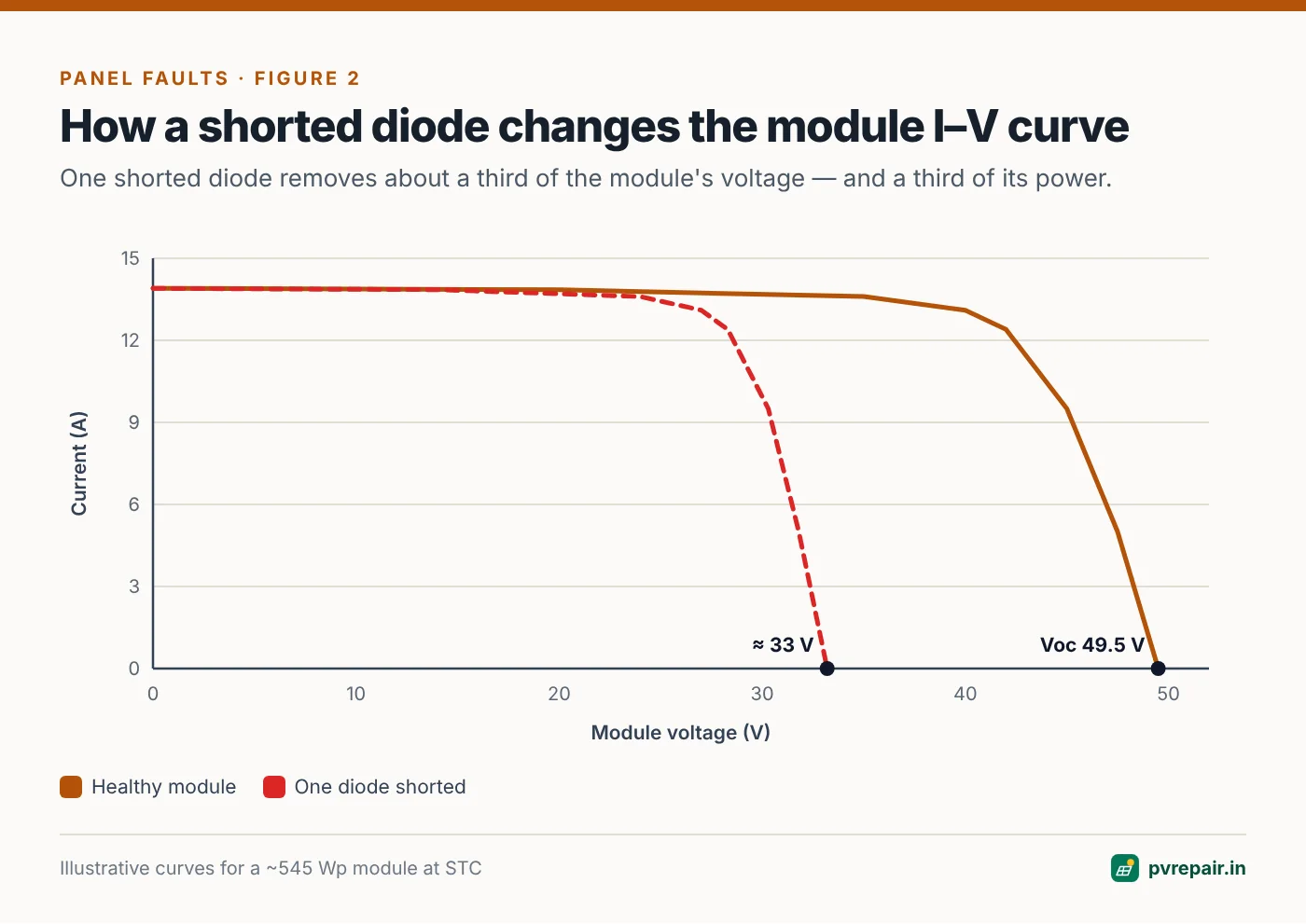
A diode that fails short-circuit conducts all the time. Its substring is permanently bypassed, whether it's shaded or not. The module's output voltage drops by roughly a third, and its power drops by a third.
Common causes:
- Lightning and surges. Induced voltages from nearby strikes can destroy diodes.
- Overheating. Diodes that spend long periods conducting (due to chronic shading) run hot. Junction boxes with poor heat dissipation, or diodes near their thermal limit, fail over time.
- Manufacturing defects in the diode or its soldering.
- Reverse polarity events during installation or testing.
Effect on the system: the string's operating voltage drops by one-third of a module's voltage. On a long string, this may only reduce output by a few percent. But because the whole string is at a lower voltage, a string with several shorted diodes may fall towards the bottom of the MPPT window in hot weather.
Failed open
A diode that fails open-circuit never conducts. In unshaded conditions, the module works normally and you won't notice anything. But when shading occurs, the substring has no bypass path. The shaded cells are forced into reverse bias, and hotspots develop. This is a safety risk — it can lead to burnt cells, scorched backsheets and, in extreme cases, fire.
Open diodes are harder to find because there's no symptom until shading happens. Thermal imaging under partial shading or a dedicated diode test is required.
Symptoms of a failed bypass diode
- Low string voltage: string Voc or operating voltage lower than expected by about one-third of a module's Voc per failed diode.
- A step in the I–V curve when traced, even without shading.
- A third of a module showing as warm on a thermal image (in the short-circuit case, the bypassed substring runs warmer because it's not producing; it absorbs sunlight without converting it).
- A hot junction box — conducting diodes dissipate heat.
- Hotspots or burn marks on one substring after shading (in the open-circuit case).
- Lower generation from one string compared with similar strings on the same inverter.
How to test for a failed diode
Work safely
These tests involve live DC circuits in daylight. They should be done by trained personnel using CAT III 1000 V (or higher) rated instruments, insulated gloves and safety glasses. Never disconnect connectors under load.
Method 1: String Voc comparison
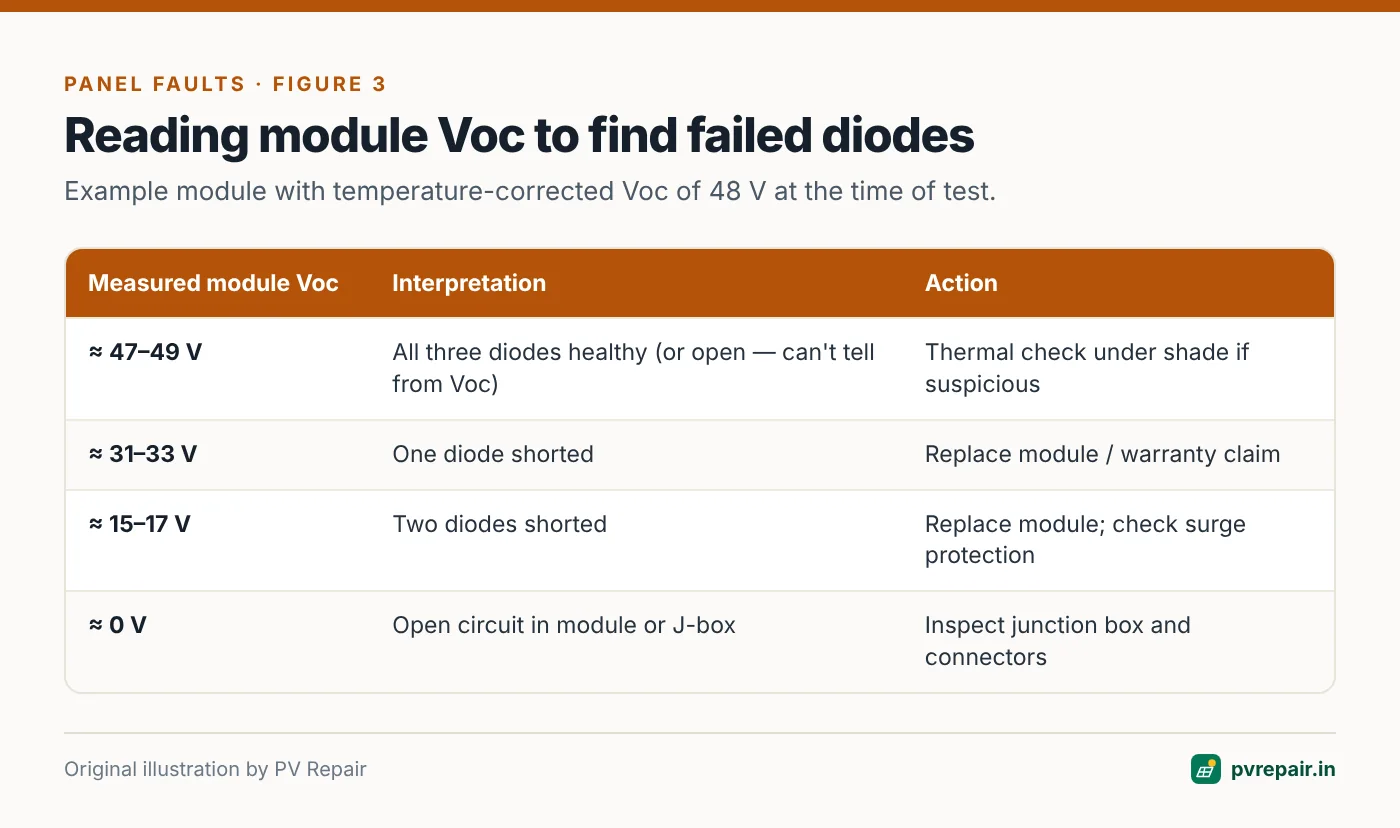
Measure the open-circuit voltage of each string at the combiner or inverter input with the DC isolator OFF. Compare strings of the same length and orientation measured at the same time. A string that's lower by roughly one-third of one module's Voc (for example, about 16 V for a module with 49 V Voc) likely has one shorted diode. See our guide to string testing with a multimeter.
Method 2: Module-by-module Voc
Isolate the suspect string, then measure Voc at each module's connectors (disconnecting modules one at a time with no current flowing). A healthy module reads close to its temperature-corrected Voc. A module with one shorted diode reads about two-thirds of that; with two shorted diodes, about one-third.
Method 3: I–V curve tracing
An I–V curve tracer measures the full current–voltage curve of a string or module. A shorted diode shows as a reduced open-circuit voltage; partial shading with healthy diodes shows as distinct steps. I–V tracing is the most informative method and is standard practice for commercial O&M.
Method 4: Thermal imaging
With the system operating at good irradiance, a shorted diode often shows as one substring being uniformly warmer than the rest of the module. The junction box may also be warm. To find open diodes, some technicians deliberately shade a few cells in each substring and watch for a hotspot developing instead of the substring bypassing — this should be done carefully and briefly.
Method 5: Direct diode test
On junction boxes that can be opened (not potted), a diode can be tested directly with the multimeter's diode function, with the module disconnected and covered so it produces no voltage. A healthy Schottky diode shows a forward voltage of roughly 0.2–0.5 V in one direction and open circuit in the other. A shorted diode shows near zero both ways; an open diode shows open both ways.
Repair options
Replace the diode
Some junction boxes have snap-in or screw-terminal diodes that can be replaced. If the manufacturer permits it and you have the exact replacement part (same current rating, voltage rating and package), a trained technician can replace a diode. However:
- Many modern junction boxes are potted (filled with silicone or resin) and can't be opened without damaging them.
- Opening a junction box may void the module warranty.
- Replacement diodes must have matching or better ratings; under-rated diodes will fail again.
- The junction box must be properly re-sealed to keep its IP rating.
Replace the module
For most residential and commercial systems, replacing the module is the practical solution, especially if the module is under warranty. Keep your measurements, thermal images and the module serial number for the warranty claim.
Fix the root cause
If diodes fail repeatedly in the same area, look for a cause: chronic shading that keeps diodes conducting for hours every day, poor surge protection and earthing, or a batch problem with a particular module model. See earthing and lightning protection mistakes and hotspots.
How much power does a failed diode cost?
A shorted diode removes about a third of one module's output. On a 10-module string of 540 Wp modules, that's about 180 W out of 5.4 kW — roughly 3.3% of the string. Over a year in a sunny Indian location, that might be 250–300 kWh lost from one diode. Several failed diodes across an array add up quickly, and the voltage drop can push strings out of the MPPT range in hot weather.
Preventing diode failures
- Avoid chronic partial shading during design and after installation. Diodes conducting for hours daily run hot and age faster.
- Install and maintain surge protection on the DC side and proper equipotential bonding.
- Choose modules from manufacturers with robust junction box designs and good diode thermal management.
- Include string Voc comparisons in routine maintenance. A shorted diode shows up clearly in a simple table of string voltages.
Frequently Asked Questions
How many bypass diodes does a solar panel have?
Most standard modules have three bypass diodes, each protecting a third of the cells. Some smaller or specialised modules have fewer or more.
Can a solar panel work with a failed bypass diode?
Yes. With a shorted diode, the module works at about two-thirds of its normal output. With an open diode, it works normally until shaded, when it risks developing hotspots.
Is a failed bypass diode covered by warranty?
Diode failures due to manufacturing defects are typically covered by the product warranty. Failures caused by lightning, installation errors or physical damage may not be. Document the failure with measurements and images.
Can I replace a bypass diode myself?
Only if the junction box is designed for it, the manufacturer permits it, and you are trained to work on PV systems. In many modern modules, the junction box is potted and the diodes aren't replaceable.
Why does my string voltage drop by around 16 V?
A drop of about one-third of one module's Voc is the classic signature of a single shorted bypass diode. Measure module by module to find which one.
Related guides
Delamination, Backsheet Cracks and Broken Glass: Can a Damaged Solar Panel Be Repaired?
How to recognise delamination, backsheet cracking, chalking and broken glass on solar modules, why each one is a safety and performance risk, and which repair options are realistic versus when replacement is the only safe choice.
Potential Induced Degradation (PID) in Solar Panels: Detection, Recovery and Prevention
What PID is, why it affects modules near the negative end of a string in hot, humid climates, how to recognise the pattern in data and EL images, and how anti-PID devices and design choices can recover and prevent losses.
Microcracks and Snail Trails in Solar Panels: What They Mean for Performance and Warranty
How microcracks form in solar cells, why snail trails appear along them, how electroluminescence and thermal imaging reveal cracks, and when cracked modules need replacing or a warranty claim.